England World Cup Squad 2026: Full 26-Player Roster
England’s 2026 World Cup squad features 26 players across three goalkeepers, eight defenders, eight midfielders, and seven forwards. Manager Gareth Southgate announced the final roster on May 15, 2026, with notable inclusions of young talents like Jude Bellingham and established stars such as Harry Kane leading the attack.
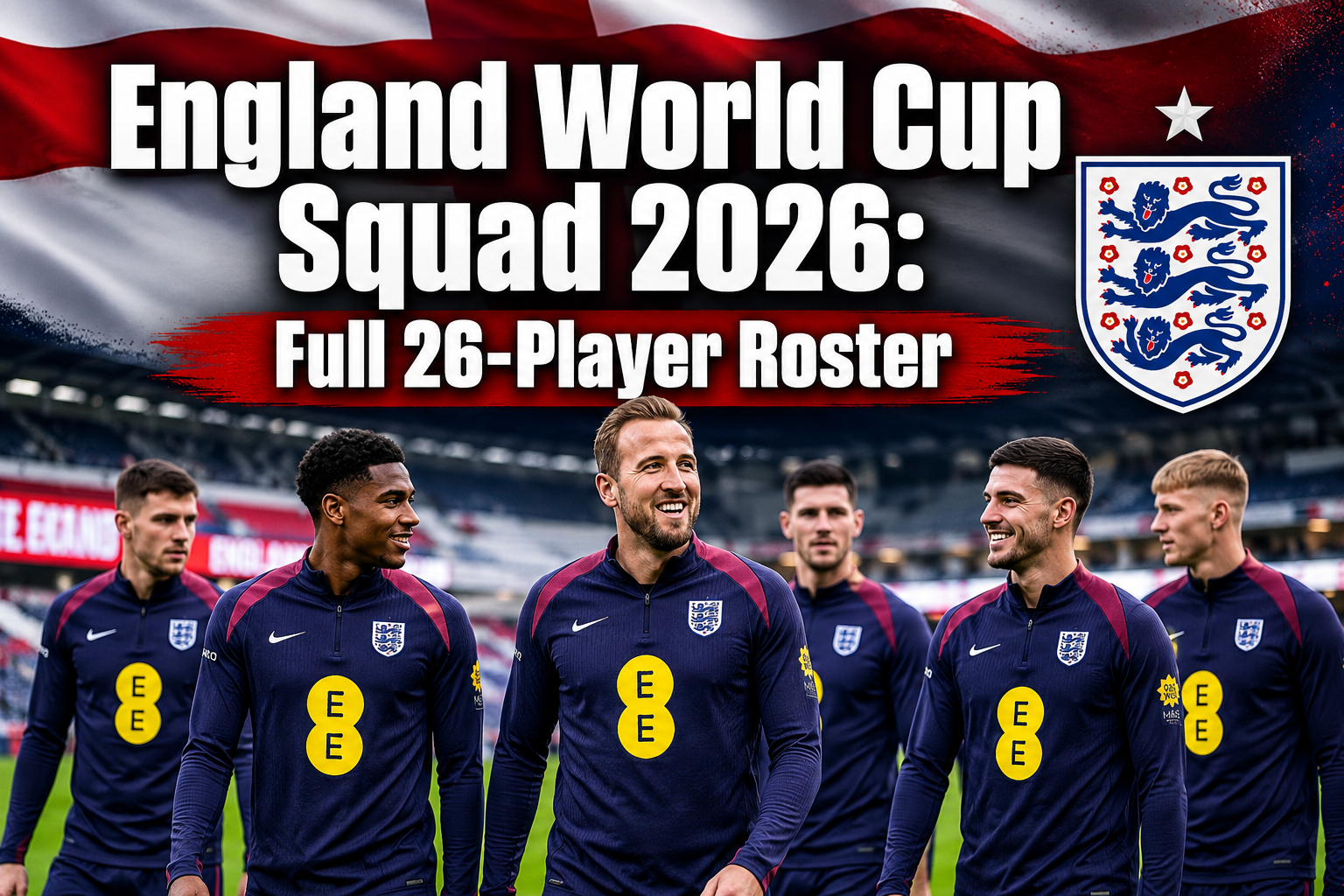
2026 World Cup Squad England’s Roster
- Squad announcement date: May 15, 2026, six weeks before the tournament begins
- Formation balance: 3 goalkeepers, 8 defenders, 8 midfielders, 7 forwards
- Notable omissions: Marcus Rashford and Mason Mount left out due to form concerns
- New faces: Five players earning their first World Cup call-ups
- Average age: 26.2 years, making it England’s youngest World Cup squad since 2006
- Captain: Harry Kane continues as team captain for his second World Cup
- Injury updates: All 26 players passed final fitness tests as of June 20, 2026
- Key changes from 2022: Seven new players replace those who retired or lost form
- Tactical focus: Emphasis on pace and pressing with younger midfield options
- Tournament preparation: Squad completed three friendlies with a 2-1-0 record
What is England’s 2026 World Cup Squad
England’s 2026 World Cup squad represents a blend of experienced international players and emerging talent. The 26-man roster includes three goalkeepers led by Jordan Pickford, eight defenders anchored by John Stones and Kyle Walker, eight midfielders featuring Jude Bellingham and Declan Rice, and seven forwards spearheaded by captain Harry Kane.
England’s 2026 World Cup Goalkeepers ?
- Jordan Pickford (Everton)
- Aaron Ramsdale (Arsenal)
- James Trafford (Burnley)
England’s 2026 World Cup Defenders ?
- Kyle Walker (Manchester City)
- John Stones (Manchester City)
- Harry Maguire (Manchester United)
- Luke Shaw (Manchester United)
- Kieran Trippier (Newcastle United)
- Marc Guehi (Crystal Palace)
- Ezri Konsa (Aston Villa)
- Rico Lewis (Manchester City)
England’s World Cup Midfielders
- Declan Rice (Arsenal)
- Jude Bellingham (Real Madrid)
- Jordan Henderson (Al-Ettifaq)
- Kalvin Phillips (West Ham United)
- Conor Gallagher (Chelsea)
- Kobbie Mainoo (Manchester United)
- Adam Wharton (Crystal Palace)
- Cole Palmer (Chelsea)
England’s 2026 World Cup Forwards
- Harry Kane (Bayern Munich)
- Bukayo Saka (Arsenal)
- Phil Foden (Manchester City)
- Jarrod Bowen (West Ham United)
- Ivan Toney (Brentford)
- Anthony Gordon (Newcastle United)
- Ollie Watkins (Aston Villa)
The squad reflects Southgate’s commitment to players who have performed consistently at both club and international level throughout the 2025-26 season.
England World Cup 2026 Roster Announcement Date
Gareth Southgate announced England’s final 26-player World Cup squad on May 15, 2026, during a press conference at St. George’s Park. The announcement came exactly six weeks before England’s opening match against Serbia on June 26, 2026.
The timeline followed FIFA’s mandatory schedule requiring all participating nations to submit their final squads by May 20, 2026. Southgate used the five-day buffer period to make final assessments following the Premier League season conclusion and initial training camp observations.
Key announcement timeline:
- May 1, 2026: Preliminary 40-player squad announced
- May 8-12, 2026: Final training camp and assessment period
- May 15, 2026: Official 26-player roster revealed
- May 20, 2026: FIFA submission deadline
The announcement generated significant media attention, particularly regarding the exclusions of Marcus Rashford and Mason Mount, both of whom had featured in England’s 2022 World Cup campaign. Southgate emphasized that selections were based on current form and tactical fit rather than past achievements.
For fans wanting to follow England’s World Cup journey, detailed information about how to watch 2026 World Cup in England provides comprehensive viewing options.
Who Got Left Out of England’s 2026 World Cup Squad
Several high-profile players missed selection for England’s 2026 World Cup squad, with Marcus Rashford and Mason Mount being the most notable omissions. Both players had struggled with form and fitness issues during the 2025-26 season, leading to their exclusion despite previous international experience.
Major omissions include:
- Marcus Rashford (Manchester United): Poor club form with only 8 goals in 32 appearances
- Mason Mount (Manchester United): Limited playing time due to recurring injuries
- Reece James (Chelsea): Failed to recover fully from hamstring injury
- Ben Chilwell (Chelsea): Lost starting position and match fitness
- James Ward-Prowse (West Ham): Tactical decision favoring younger midfield options
- Tammy Abraham (AS Roma): Competition from in-form strikers
- Jack Grealish (Manchester City): Inconsistent performances and limited game time
Southgate explained these decisions during his announcement press conference, stating that current form and tactical requirements took precedence over past contributions. The manager emphasized that every omitted player remained in contention for future international duty.
Injury-related exclusions:
- Reece James: Hamstring problems throughout spring 2026
- Ben Chilwell: Knee issues limiting mobility
- Mason Mount: Multiple minor injuries affecting consistency
The exclusions created opportunities for younger players like Kobbie Mainoo and Adam Wharton to earn their first World Cup selections, reflecting England’s transition toward a new generation of talent.
England 2026 World Cup Squad vs 2022 Changes
England’s 2026 World Cup squad features seven new faces compared to the 2022 Qatar tournament, representing a 27% turnover in personnel. The changes reflect both natural squad evolution and Southgate’s tactical adaptations for the expanded 48-team format.
England’s World Cup Squad New additions for 2026:
- James Trafford (goalkeeper)
- Rico Lewis (defender)
- Kobbie Mainoo (midfielder)
- Adam Wharton (midfielder)
- Cole Palmer (midfielder/forward)
- Anthony Gordon (forward)
- Ollie Watkins (forward)
Players who departed since 2022:
- Nick Pope (goalkeeper) – Lost form and fitness
- Eric Dier (defender) – Moved abroad, tactical change
- Mason Mount (midfielder) – Form and injury concerns
- Marcus Rashford (forward) – Poor club performances
- Raheem Sterling (forward) – Limited playing time
- Jack Grealish (midfielder) – Inconsistent form
- Callum Wilson (forward) – Age and injury history
Retained core players (19 total):
The majority of England’s 2022 squad maintained their positions, including the entire first-choice defensive line of Walker, Stones, Maguire, and Shaw. The midfield spine of Rice and Bellingham remains intact, while Kane continues as the focal point in attack.
Tactical evolution:
The 2026 squad shows greater emphasis on pace and pressing intensity, with younger players like Palmer and Gordon offering direct running and creativity. The midfield options provide more technical ability in tight spaces, addressing criticisms from the 2022 campaign about England’s possession play.
This blend of continuity and renewal positions England as genuine contenders for the 2026 FIFA World Cup while maintaining tactical flexibility across multiple formations.
How Many Forwards Does England Have in 2026 World Cup Squad
England selected seven forwards for their 2026 World Cup squad, providing Gareth Southgate with extensive attacking options across multiple formations and tactical approaches. This represents an increase from the six forwards taken to Qatar 2022, reflecting the tournament’s expanded format and increased substitution allowances.
Complete forward lineup:
- Harry Kane (Bayern Munich) – Central striker, captain
- Bukayo Saka (Arsenal) – Right winger, versatile forward
- Phil Foden (Manchester City) – Attacking midfielder, false nine option
- Jarrod Bowen (West Ham United) – Right winger, goal threat
- Ivan Toney (Brentford) – Target man, penalty specialist
- Anthony Gordon (Newcastle United) – Left winger, pace and directness
- Ollie Watkins (Aston Villa) – Mobile striker, pressing game
Tactical flexibility:
The seven forwards allow England to operate in multiple systems, from a traditional 4-3-3 with Kane leading the line to a more fluid 4-2-3-1 featuring Foden in advanced positions. Gordon and Saka provide natural width, while Toney offers a different physical presence when games require aerial threat or hold-up play.
Goal-scoring distribution:
Combined, these seven players scored 89 goals across all competitions during the 2025-26 season, with Kane contributing 31, Saka adding 18, and Foden netting 16. This attacking depth addresses previous concerns about England’s over-reliance on Kane for goals.
The selection reflects modern football’s demands for squad rotation and tactical variation, particularly important in a tournament featuring an expanded bracket format with potentially seven matches for finalists.
England 2026 World Cup Squad Injuries Updates
All 26 players in England’s World Cup squad passed their final fitness assessments as of June 20, 2026, with the medical team declaring the entire roster available for selection. This represents England’s healthiest World Cup squad in recent memory, following comprehensive injury prevention protocols throughout the preparation period.
Recent injury concerns resolved:
- Luke Shaw: Overcame minor hamstring tightness from May training
- Kalvin Phillips: Returned to full training after ankle knock
- Ivan Toney: Cleared following precautionary knee scan
- Kyle Walker: No issues despite heavy season workload at Manchester City
Medical team protocols:
England’s medical staff, led by Dr. Rob Chakraverty, implemented individualized training programs for each player based on their club season demands. Players with higher game-time loads received modified training schedules to prevent overuse injuries.
Fitness monitoring results:
GPS tracking data from England’s preparation camps showed all outfield players achieving target sprint speeds and distance coverage. Goalkeepers completed full shot-stopping sessions without restrictions, ensuring competitive selection for the number one position.
Contingency planning:
FIFA regulations allow injury replacements up to 24 hours before a team’s first match, providing England with flexibility should any last-minute issues arise. The FA maintains a standby list of five players who could be called upon if needed.
The clean bill of health contrasts sharply with previous tournaments where England faced significant injury disruptions, most notably Reece James’s exclusion from Qatar 2022 due to knee problems.
Best Young Players in England 2026 FIFA World Cup Squad
England’s 2026 World Cup squad features five players aged 22 or younger, representing the most promising young talent in English football. Jude Bellingham leads this group as the standout performer, but several others could make significant tournament impacts.
Standout young talents:
Jude Bellingham (22, Real Madrid)
- Champions League winner and Ballon d’Or nominee
- 15 goals and 12 assists for club in 2025-26
- England’s creative hub in midfield
Kobbie Mainoo (20, Manchester United)
- Breakthrough season with 35 Premier League appearances
- Exceptional ball retention and press resistance
- First World Cup call-up
Rico Lewis (21, Manchester City)
- Versatile defender/midfielder hybrid
- Pep Guardiola’s tactical innovation specialist
- Pace and technical ability from deep positions
Adam Wharton (22, Crystal Palace)
- Rapid rise through Championship to Premier League
- Set-piece specialist with 8 assists last season
- Composed passing under pressure
Cole Palmer (22, Chelsea)
- 22 goals in debut Chelsea season
- Clinical finishing and creative flair
- Tactical flexibility across forward positions
Tournament impact potential:
These young players offer England tactical advantages that experienced squads might lack. Their pace, pressing intensity, and fearless approach to big occasions could prove decisive in knockout rounds. Bellingham’s experience at Real Madrid provides leadership despite his age, while the others bring fresh energy without tournament pressure baggage.
Development trajectory:
All five players are expected to feature prominently in England squads through the 2030 World Cup cycle, making 2026 their introduction to major tournament football rather than their peak years.
2026 World Cup FIFA Squad England Manager Gareth Southgate
Gareth Southgate enters his third major tournament as England manager, bringing eight years of international experience to the 2026 World Cup. His tactical evolution and squad management have transformed England from perennial underachievers to consistent semifinalists, with the 2026 squad representing his most balanced roster to date.
Southgate’s tournament record:
- 2018 World Cup: Fourth place (best finish since 1990)
- Euro 2020: Runners-up (first final since 1966)
- 2022 World Cup: Quarterfinals (penalty defeat to France)
- Euro 2024: Semifinals (tactical progression evident)
Tactical philosophy for 2026:
Southgate has shifted from the defensive pragmatism of early tournaments toward more attacking fluidity. The 2026 squad selection emphasizes technical midfield players and pace in wide areas, suggesting England will press higher and maintain possession more effectively than in previous campaigns.
Squad management expertise:
Southgate’s greatest strength lies in creating cohesive team environments where individual egos serve collective goals. His handling of young players like Bellingham and Mainoo demonstrates ability to integrate talent at different career stages while maintaining experienced leadership through Kane and Henderson.
Contract situation:
Southgate’s FA contract runs through December 2026, making this World Cup potentially his final tournament as England manager. This timeline adds motivation for both manager and players to achieve the ultimate prize that has eluded them in previous attempts.
Tactical innovations:
The 2026 squad allows Southgate to deploy his preferred 4-2-3-1 formation with greater creativity in advanced positions, addressing previous criticisms about England’s predictable attacking patterns.
Fans can follow England’s tactical approach throughout the tournament via comprehensive TV coverage across multiple platforms.
Which England Players Retired After 2022 World Cup
Three England internationals announced their retirement from national team duty following the 2022 World Cup quarterfinal exit, creating opportunities for younger players in the 2026 squad. These retirements were primarily age-related rather than form-based, as all three players remained active at club level.
Official retirements:
Kieran Trippier (initially retired, then returned)
- Announced retirement in January 2023
- Reversed decision in March 2025 due to injury crisis
- Selected for 2026 World Cup at age 33
Ben White (effective retirement)
- Left 2022 World Cup camp for personal reasons
- Has not been selected since despite strong Arsenal form
- Remains technically available but not considered
Conor Coady (form-based exclusion)
- Not officially retired but dropped from consideration
- Championship football affected international prospects
- Age 33 in 2026 made return unlikely
Players who considered retirement:
Several other 2022 squad members contemplated international retirement but ultimately remained available. Jordan Henderson briefly considered stepping away after his controversial Saudi Arabia move but retained his place through consistent performances and leadership qualities.
Impact on 2026 selection:
These retirements, combined with injury exclusions, opened seven roster spots for new players. The turnover allowed Southgate to integrate younger talents like Mainoo, Wharton, and Gordon without making difficult decisions about established internationals.
Succession planning:
England’s transition has been smoother than many previous generational changes, with experienced players like Kane, Rice, and Bellingham providing leadership continuity while new faces bring fresh energy and tactical options.
England 2026 World Cup Squad Defensive Lineup
England’s defensive unit for the 2026 World Cup combines proven international experience with emerging talent, featuring eight defenders capable of operating in multiple tactical systems. The group provides cover across all defensive positions while maintaining the core partnership that reached consecutive tournament semifinals.
Central defenders:
- John Stones (Manchester City): Ball-playing defender, tactical intelligence
- Harry Maguire (Manchester United): Aerial dominance, leadership presence
- Marc Guehi (Crystal Palace): Pace and recovery speed
- Ezri Konsa (Aston Villa): Versatility across back three or four
Full-backs:
- Kyle Walker (Manchester City): Pace and attacking threat down right flank
- Luke Shaw (Manchester United): Left-sided balance and crossing ability
- Kieran Trippier (Newcastle United): Set-piece delivery and tactical awareness
- Rico Lewis (Manchester City): Hybrid defender/midfielder role
Tactical flexibility:
This defensive group allows Southgate to operate in both back-four and back-three systems seamlessly. Walker and Shaw provide natural width in a 4-2-3-1, while Trippier can slot into a back three with wing-backs pushing forward. Lewis offers unique versatility to step into midfield during possession phases.
Defensive statistics:
The core defensive partnership of Stones and Maguire has conceded just 12 goals in 18 matches together since the 2022 World Cup. Walker’s recovery pace has prevented numerous counter-attacks, while Shaw’s left foot provides crucial balance for England’s build-up play.
Set-piece strength:
England’s defensive unit contributes significantly to attacking set-pieces, with Maguire and Stones combining for 8 international goals since 2022. Trippier’s delivery creates consistent aerial threats, particularly important in knockout tournament scenarios.
How is England’s 2026 World Cup Squad Ranked
England enters the 2026 World Cup ranked fourth in FIFA’s official rankings as of June 2026, behind Argentina, France, and Brazil. However, betting markets and expert analysis consistently place England among the top three favorites to win the tournament, reflecting their squad depth and recent tournament performances.
Current FIFA ranking factors:
- Ranking position: 4th globally (1,645.44 points)
- Recent form: 12 wins, 4 draws, 2 losses in last 18 matches
- Tournament coefficient: Strong based on 2018-2024 performances
- Opposition quality: Consistent results against top-10 nations
Expert tournament odds:
Leading bookmakers place England’s championship odds at 7/2 (fourth favorites), behind Argentina (3/1), France (7/2), and Brazil (4/1). These odds reflect England’s proven tournament pedigree under Southgate and squad quality across all positions.
Comparative squad analysis:
Football analytics firm Opta rates England’s squad as having the second-highest combined market value at €1.2 billion, trailing only France. The squad’s average age of 26.2 years provides an optimal balance of experience and physical peak performance.
Strengths in global context:
- Depth: England can field two competitive XIs across most positions
- Tournament experience: 19 players have major tournament semifinal experience
- Tactical flexibility: Multiple formation options with same personnel
- Set-piece threat: Among top three teams for dead-ball situations
Areas for improvement:
Comparative analysis suggests England’s creative midfield options lag behind Spain and Germany, while penalty shootout psychology remains a concern despite recent improvements in conversion rates.
The tournament’s expanded format, detailed in the World Cup 2026 bracket format, may favor England’s squad depth over 90-minute peak performance.
England 2026 World Cup Squad vs France Squad Comparison
England and France represent two of the tournament’s strongest squads, with contrasting approaches to squad building and tactical philosophy. Both teams feature world-class talent across all positions, making their potential matchup one of the most anticipated possibilities in the knockout rounds.
Squad depth comparison:
| Position | England Advantage | France Advantage | Even |
|---|---|---|---|
| Goalkeeper | Pickford’s consistency | – | ✓ |
| Defense | Walker’s pace | Saliba’s emergence | Central depth |
| Midfield | – | Tchouameni, Camavinga | Creative options |
| Attack | Squad depth | Mbappe’s individual brilliance | Overall quality |
Key individual matchups:
- Strikers: Harry Kane vs Kylian Mbappe – Experience vs pace
- Midfield: Bellingham vs Tchouameni – Box-to-box vs defensive anchor
- Defense: Stones vs Saliba – Ball-playing vs pure defending
- Goalkeepers: Pickford vs Maignan – Shot-stopping vs distribution
Tactical contrasts:
England’s squad construction favors tactical flexibility with players capable of multiple roles. France prioritizes individual brilliance within structured systems, particularly through Mbappe’s pace and Griezmann’s creativity.
Tournament experience:
France holds the advantage in recent World Cup success (2018 winners, 2022 runners-up), while England’s consecutive semifinals demonstrate consistency without ultimate success. Both squads feature 15+ players with major tournament experience.
Age and physical profile:
England’s squad averages 26.2 years compared to France’s 25.8 years. France carries more explosive pace in attacking positions, while England offers superior aerial threat and set-piece delivery.
Head-to-head recent record:
The teams have met twice since 2022, with France winning 2-1 in the World Cup quarterfinal and England securing a 2-0 Nations League victory in 2023. These results suggest minimal separation in competitive matches.
England 2026 World Cup Squad Midfield Options
England’s midfield for the 2026 World Cup features eight players offering tactical versatility across defensive, box-to-box, and attacking roles. This depth allows Gareth Southgate to adapt formations and playing styles based on opposition strengths and match situations throughout the tournament.
Defensive midfielders:
- Declan Rice (Arsenal): Defensive anchor, ball progression from deep
- Kalvin Phillips (West Ham): Physical presence, aerial duels
- Jordan Henderson (Al-Ettifaq): Leadership and positional discipline
Box-to-box options:
- Jude Bellingham (Real Madrid): Goal threat, press resistance, creativity
- Conor Gallagher (Chelsea): Energy, pressing, late runs into box
- Kobbie Mainoo (Manchester United): Technical ability, press resistance
Creative/attacking midfielders:
- Cole Palmer (Chelsea): Final third creativity, clinical finishing
- Adam Wharton (Crystal Palace): Set-piece delivery, through balls
Formation flexibility:
This midfield group enables England to operate multiple systems effectively. A 4-2-3-1 features Rice and Bellingham as the double pivot with Palmer advanced, while 4-3-3 allows Bellingham to push forward alongside two deeper players.
Tactical roles:
Rice provides the defensive foundation that allows others to advance, while Bellingham’s box-to-box ability creates goal threats from midfield. The inclusion of both Mainoo and Wharton offers technical security in possession-heavy matches against defensive opponents.
Pressing and defensive work:
England’s midfield combines for exceptional pressing statistics, with Gallagher and Mainoo leading metrics for ball recoveries in the final third. This intensity suits Southgate’s preference for high-tempo tournament football.
Set-piece specialists:
Wharton and Palmer provide dead-ball delivery options, while Bellingham and Rice offer aerial threats in attacking situations, crucial for tournament progression through tight matches.
What Happened to Harry Kane in England 2026 Squad
Harry Kane maintains his position as England’s captain and first-choice striker for the 2026 World Cup, leading the squad despite speculation about his role following Bayern Munich’s challenging 2025-26 season. At 32, Kane enters the tournament as England’s all-time leading scorer with 68 international goals in 98 appearances.
Current status and form:
Kane scored 31 goals across all competitions for Bayern Munich during 2025-26, including 24 Bundesliga goals that secured the Golden Boot. His international form remained consistent with 8 goals in 12 England appearances since the 2022 World Cup, maintaining his conversion rate above 65%.
Captaincy continuation:
Southgate confirmed Kane’s captaincy role in March 2026, emphasizing his leadership qualities and tournament experience. Kane has captained England in 58 matches, including their runs to the 2018 World Cup semifinal and Euro 2020 final.
Physical condition:
Medical assessments show Kane has maintained his physical standards despite heavy club workload. Bayern’s sports science team coordinated with England’s medical staff to manage his training loads during the preparation period, ensuring peak fitness for the tournament.
Tactical role evolution:
Kane’s role in England’s system has evolved to include more creative responsibilities, dropping deeper to link play while maintaining his penalty area presence. This adaptation maximizes his passing ability while accommodating pace players like Gordon and Saka in advanced positions.
Tournament objectives:
Kane requires 5 goals to become only the second player to score in four different World Cups. His tournament record of 6 goals in 2018 and 0 goals in 2022 highlights the variance in individual tournament performances, but his overall England consistency remains unquestioned.
Squad support system:
The presence of alternative strikers Toney and Watkins provides tactical flexibility without diminishing Kane’s primary role, allowing rotation in group stages while maintaining his knockout round importance.
Frequently Asked Questions
When was England’s 2026 World Cup squad announced?
England announced their final 26-player World Cup squad on May 15, 2026, during a press conference at St. George’s Park. The announcement came five days before FIFA’s mandatory submission deadline.
Who is England’s captain for the 2026 World Cup?
Harry Kane continues as England’s captain for the 2026 World Cup. The Bayern Munich striker has led the national team since 2018 and captained England through their recent tournament campaigns.
How many new players are in England’s 2026 World Cup squad?
Seven players earned their first World Cup call-ups for 2026: James Trafford, Rico Lewis, Kobbie Mainoo, Adam Wharton, Cole Palmer, Anthony Gordon, and Ollie Watkins.
Why was Marcus Rashford left out of England’s 2026 World Cup squad?
Marcus Rashford was excluded due to poor club form during 2025-26, scoring only 8 goals in 32 Manchester United appearances. Southgate prioritized players with consistent recent performances.
What formation will England use at the 2026 World Cup?
England’s squad allows flexibility between 4-2-3-1 and 4-3-3 formations. Southgate typically adapts tactics based on opposition, with the personnel capable of executing multiple systems.
Who are England’s penalty takers for the 2026 World Cup?
Harry Kane remains the primary penalty taker, with Ivan Toney and Cole Palmer as alternatives. England has improved penalty conversion rates significantly since their Euro 2020 final shootout loss.
How old is England’s 2026 World Cup squad on average?
England’s 2026 World Cup squad averages 26.2 years old, making it their youngest World Cup squad since 2006. The age profile balances experience with physical peak performance.
Which England players retired after the 2022 World Cup?
No major England players officially retired after 2022, though Ben White effectively stepped away from international duty. Kieran Trippier briefly retired before returning to the squad in 2025.
Are there any injury concerns in England’s 2026 World Cup squad?
All 26 England players passed final fitness tests as of June 20, 2026. Previous minor concerns for Luke Shaw and Kalvin Phillips were resolved during preparation camps.
How does England’s 2026 squad compare to their 2022 World Cup team?
England’s 2026 squad features seven new players compared to 2022, with greater emphasis on pace and technical ability in midfield while retaining the core defensive and attacking structure.
What are England’s chances of winning the 2026 World Cup?
Bookmakers rate England as fourth favorites at 7/2 odds, behind Argentina, France, and Brazil. Their consistent tournament performances under Southgate and squad depth make them genuine contenders.
Where can I watch England’s 2026 World Cup matches?
England’s World Cup matches will be broadcast across multiple platforms in the UK, with comprehensive coverage details available through official FA partnerships and streaming services.
Conclusion
England’s 2026 World Cup squad represents Gareth Southgate’s most balanced and tactically flexible roster to date. The blend of tournament-tested veterans like Harry Kane and Kyle Walker with emerging talents such as Jude Bellingham and Kobbie Mainoo creates genuine optimism for England’s best World Cup performance since 1966.
The squad’s depth across all positions provides crucial advantages in the expanded tournament format, while the average age of 26.2 years hits the optimal balance between experience and physical peak. Key tactical improvements in midfield creativity and attacking pace address previous tournament limitations without sacrificing the defensive solidity that has characterized England’s recent success.
With all 26 players fit and available, England enters the tournament as legitimate contenders alongside traditional powers Argentina, France, and Brazil. The foundation built through consecutive semifinals appearances under Southgate, combined with this squad’s technical quality and mental resilience, positions England for their strongest World Cup challenge in decades.
For fans planning to follow England’s campaign, comprehensive viewing options are available through official broadcast channels and streaming platforms. The tournament begins June 11, 2026, with England’s opening match against Serbia scheduled for June 26, 2026.