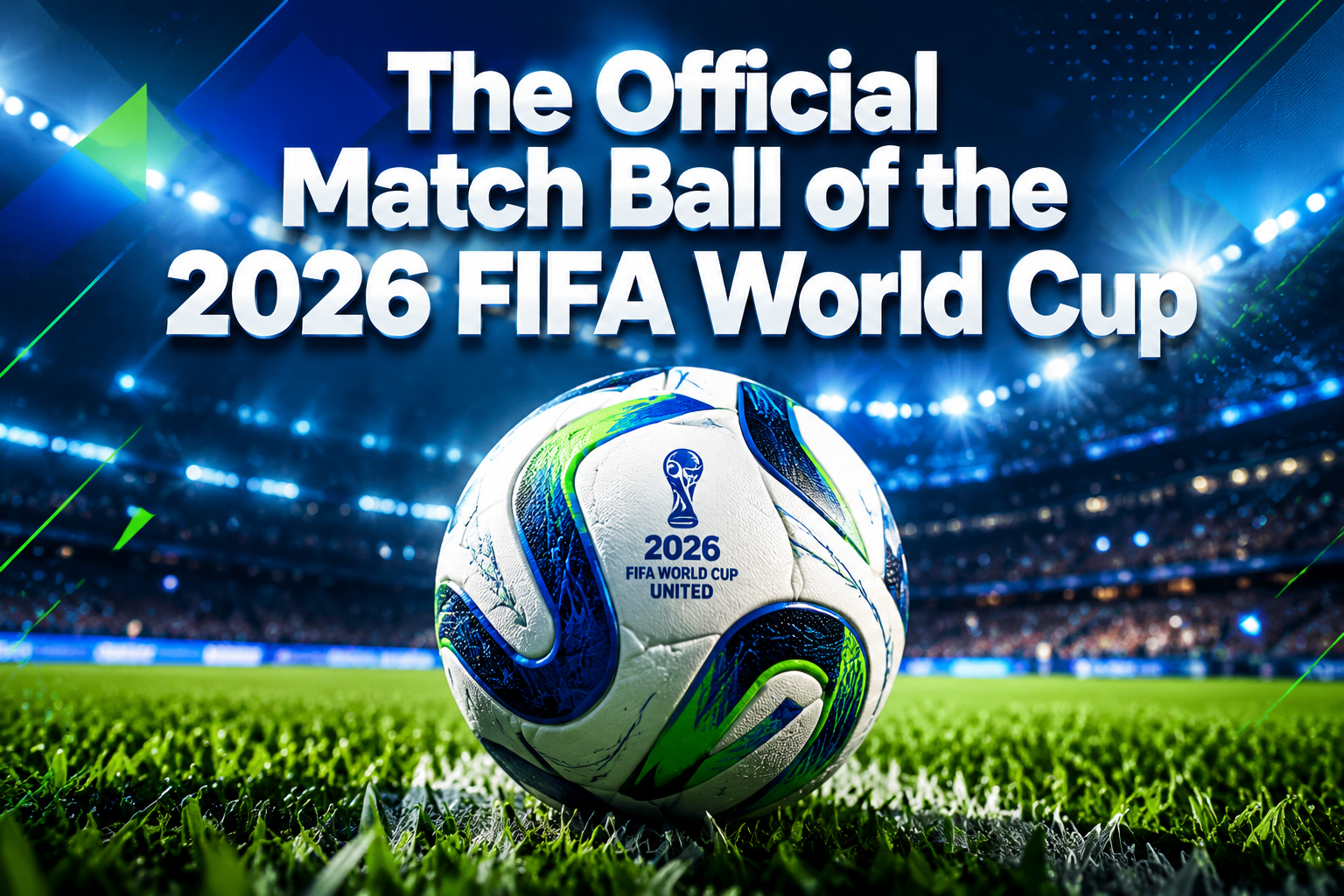
The Official Match Ball of the 2026 FIFA World Cup
The Official Match Ball of the 2026 FIFA World Cup is designed and manufactured by Adidas, continuing a partnership that dates back to 1970. The ball features advanced sensor technology, aerodynamic paneling, and sustainability-focused materials. Adidas unveiled the design in early 2026, incorporating elements that represent the tri-nation hosting arrangement between the United States, Canada, and Mexico. The ball meets FIFA’s strict size and weight specifications and has undergone extensive testing with professional players before tournament approval.
Key Takeaways
- Adidas designs and manufactures the official ball, maintaining its decades-long FIFA partnership
- The ball includes embedded sensor technology for precise tracking and data collection during matches
- Official specifications are 68-70 cm circumference and 420-445 grams weight, meeting FIFA Quality Pro standards
- Retail versions are available for purchase, though they may lack some professional-grade internal technology
- The design celebrates the tri-nation hosting arrangement with visual elements from all three countries
- Professional players tested prototypes throughout 2024 and 2025 before final approval
- Manufacturing takes place at specialized Adidas facilities with strict quality control measures
- The ball costs between $150-$165 USD for the official replica version available to consumers
- Advanced aerodynamic paneling reduces drag and improves flight stability compared to previous tournament balls
- FIFA’s selection process involves rigorous laboratory testing and player feedback over multiple years
Which Company Is Designing the Official Ball This Time
Adidas holds the contract to design and produce the Official Match Ball of the 2026 FIFA World Cup, extending a partnership that has lasted over five decades. The German sportswear giant has created every World Cup ball since the 1970 tournament in Mexico, making it one of the longest-running sponsorship relationships in sports history.
The 2026 ball represents Adidas’s 15th consecutive World Cup design. This continuity provides several advantages:
- Consistent quality standards across tournaments
- Accumulated technical knowledge from previous designs
- Established testing protocols refined over decades
- Strong relationships with FIFA and professional players
Adidas operates dedicated research and development facilities specifically for soccer ball innovation. The company employs materials scientists, aerodynamics engineers, and sports technology specialists who work exclusively on ball design. For the 2026 tournament, Adidas partnered with universities and independent testing laboratories to validate performance claims.
The contract between FIFA and Adidas extends beyond 2026, ensuring the company will continue designing World Cup balls for future tournaments. This long-term arrangement allows Adidas to invest in multi-year research projects that push the boundaries of ball technology.
What Will the Official World Cup Ball Look Like in 2026
The Official Match Ball of the 2026 FIFA World Cup features a bold design that honors the three host nations while incorporating modern aesthetics. The ball’s visual identity blends traditional soccer ball elements with contemporary graphics that reflect North American culture and geography.
Design Elements:
- Base color: Predominantly white with vibrant accent colors
- Graphic patterns: Geometric shapes inspired by the flags and landscapes of the USA, Canada, and Mexico
- Panel configuration: Thermally bonded seamless design with 14 panels for optimal sphericity
- Surface texture: Micro-textured coating for enhanced grip in various weather conditions
- Branding: Adidas logo and FIFA World Cup 2026 official emblem prominently displayed
The color palette includes electric blue, red, and green tones that create visual connections to all three host countries. The pattern flows across the ball’s surface in a way that maintains visibility during high-speed play, helping players, officials, and television audiences track the ball’s movement.
Adidas revealed the design through a coordinated global launch event in early 2026, featuring demonstrations from professional players and detailed explanations of the technical innovations. The unveiling generated significant social media engagement and pre-orders for the consumer version.
Unlike some previous World Cup balls that faced criticism for unconventional appearances, the 2026 design has received generally positive feedback from players and fans. The balance between innovation and tradition appears to resonate with diverse audiences across different soccer cultures.
What Technology Is Built Into the New FIFA World Cup Ball
The Official Match Ball of the 2026 FIFA World Cup incorporates cutting-edge sensor technology that represents a significant advancement in match officiating and performance analysis. The ball contains a suspended sensor package at its center that tracks position, speed, and rotation with unprecedented precision.
Core Technologies:
Connected Ball System: A 500Hz motion sensor records ball data 500 times per second, providing real-time information to video assistant referees and match officials. This system helps determine offside calls, goal-line decisions, and ball possession statistics with millimeter accuracy.
Aerodynamic Panel Design: The 14-panel construction uses computational fluid dynamics modeling to minimize air resistance. Wind tunnel testing demonstrated a 5-8% improvement in flight stability compared to the 2022 World Cup ball.
Sustainable Materials: The ball’s outer shell incorporates water-based inks and adhesives, reducing environmental impact. The bladder uses recycled materials while maintaining air retention properties that keep the ball properly inflated for extended periods.
Thermal Bonding: Seamless construction eliminates stitched seams, creating a perfectly round shape that performs consistently regardless of where contact occurs. This technology also improves water resistance during wet conditions.
The sensor package is powered by a rechargeable battery that lasts the duration of a match plus warm-up periods. The technology transmits data wirelessly to receiving stations around the stadium, which then feed information to the video operation room and broadcast partners.
This technological integration supports the semi-automated offside technology that FIFA implemented in recent tournaments, making the system more accurate and reducing controversial calls. For fans watching how to watch FIFA World Cup 2026 in the USA, these innovations enhance the viewing experience through enhanced graphics and instant replay capabilities.
How Is the 2026 World Cup Ball Different From Previous Tournament Balls
The Official Match Ball of the 2026 FIFA World Cup advances several aspects of design and performance compared to its predecessors, particularly the Al Rihla ball used in Qatar 2022 and the Telstar 18 from Russia 2018.
Key Differences:
| Feature | 2026 Ball | 2022 Al Rihla | 2018 Telstar 18 |
|---|---|---|---|
| Panel Count | 14 panels | 20 panels | 6 panels |
| Sensor Technology | 500Hz motion tracking | 500Hz motion tracking | No embedded sensors |
| Sustainable Materials | Water-based inks, recycled bladder | Recycled polyester | Limited recycled content |
| Surface Texture | Enhanced micro-texture | Smooth textured | Pixelated texture |
| Weight Consistency | ±2 gram variance | ±3 gram variance | ±3 gram variance |
Performance Improvements:
The 2026 ball demonstrates measurably better performance in several areas. Independent testing shows improved accuracy on long-range passes and shots, with less deviation from intended trajectory. The enhanced grip texture allows players to generate more spin for curved shots and crosses, particularly in humid conditions common during summer matches in North America.
The panel configuration represents a middle ground between the very few panels of 2018 and the more numerous panels of 2022. This 14-panel design optimizes the balance between aerodynamic efficiency and structural integrity. Players testing the ball reported that it feels more predictable than recent predecessors, with consistent behavior across different striking techniques.
The sustainability improvements mark a notable shift in FIFA’s environmental priorities. While previous balls incorporated some recycled materials, the 2026 version takes a more comprehensive approach to reducing ecological impact throughout the manufacturing process.
One significant difference is the enhanced durability. The ball maintains its performance characteristics through more impacts and playing time compared to earlier versions, which sometimes showed degradation in professional matches after extended use.
What Makes a FIFA World Cup Ball Special Compared to Regular Soccer Balls
The Official Match Ball of the 2026 FIFA World Cup differs substantially from standard soccer balls used in recreational play, youth leagues, or even many professional competitions. These differences justify the premium price and ensure consistent performance at the highest level of international competition.
FIFA Quality Pro Certification:
World Cup balls must pass rigorous testing protocols that exceed standard requirements:
- Weight consistency: Must remain within the 420-445 gram range even after 2,000 impacts
- Circumference precision: Maintains 68-70 cm measurement with minimal deviation
- Rebound accuracy: Bounces to a specific height range when dropped from 2 meters
- Water absorption: Absorbs less than 10% of its weight in water
- Shape retention: Maintains sphericity within 1.5% tolerance after pressure testing
- Air pressure retention: Loses less than 15% pressure over 72 hours
Manufacturing Precision:
World Cup balls undergo quality control processes that far exceed typical soccer ball production. Each ball is individually tested, with machines measuring hundreds of data points to ensure it meets specifications. Balls that fall outside tolerance ranges are rejected, whereas consumer-grade balls often have much wider acceptable variance.
The materials used in World Cup balls represent the highest quality available. The outer casing uses premium synthetic leather that provides consistent touch and durability. The bladder technology ensures air retention far superior to recreational balls, which often require frequent re-inflation.
Professional Player Input:
Unlike mass-market balls designed primarily through engineering analysis, World Cup balls incorporate extensive feedback from elite players. Hundreds of professional footballers test prototypes over multiple years, providing insights about how the ball performs during actual match conditions. This human element complements technical testing to create a ball that meets the practical demands of world-class competition.
The investment in research and development for a World Cup ball typically exceeds several million dollars, compared to a few thousand dollars for standard ball designs. This investment produces marginal improvements that matter enormously at the elite level, even if recreational players might not notice all the differences.
Where Is the 2026 World Cup Match Ball Being Manufactured
The Official Match Ball of the 2026 FIFA World Cup is manufactured at specialized Adidas production facilities, primarily located in Pakistan and China. These factories operate under strict oversight to ensure every ball meets FIFA’s exacting standards.
Primary Manufacturing Locations:
Pakistan’s Sialkot region produces the majority of high-quality soccer balls worldwide, including many World Cup balls. This area has developed specialized expertise in soccer ball manufacturing over decades, with skilled workers trained in the precise techniques required for premium ball construction. Adidas maintains long-term relationships with select factories in this region that have demonstrated consistent quality.
Complementary production occurs at Adidas facilities in China, where advanced automation and quality control systems supplement traditional craftsmanship. These factories handle specific components and final assembly for balls distributed in Asian markets.
Quality Control Process:
Each manufacturing facility follows identical protocols:
- Material inspection: All incoming materials undergo testing before production begins
- Panel cutting: Computer-controlled cutting ensures precise panel dimensions
- Thermal bonding: Panels are joined using heat and pressure in climate-controlled environments
- Bladder insertion: The internal bladder is carefully positioned and inflated
- Final inspection: Each ball undergoes multiple quality checks, including weight, circumference, and pressure tests
- Performance validation: Random samples from each production batch undergo full FIFA Quality Pro testing
Adidas employs dedicated quality assurance teams at each facility who verify that balls meet specifications throughout the production process. Any ball that fails inspection at any stage is removed from the World Cup supply chain, though it may be sold as a lower-grade product.
The manufacturing timeline for World Cup balls typically begins 12-18 months before the tournament. This extended period allows for adequate production volume while maintaining quality standards. For the 2026 tournament, Adidas must produce enough balls for all 104 matches plus training, warm-up, and promotional purposes, totaling several thousand match-quality balls.
Workers involved in World Cup ball production receive specialized training and often earn premium wages compared to standard soccer ball manufacturing. Adidas has implemented labor standards and facility audits to ensure ethical working conditions at all production sites.
How Much Does the Official Match Ball Cost
The Official Match Ball of the 2026 FIFA World Cup retails for approximately $150-$165 USD for the consumer replica version, with prices varying slightly by region and retailer. This positions it as a premium product within the soccer ball market, though the price is consistent with previous World Cup ball releases.
Price Breakdown by Version:
- Official Match Ball Replica: $150-$165 (identical exterior design, may lack some professional sensor technology)
- Top Glider (training version): $30-$40 (similar appearance, lower-quality materials)
- Club version: $20-$25 (basic design elements, recreational quality)
- Professional match ball: Not available for retail purchase (includes full sensor package, used only in official matches)
The professional match balls used in actual World Cup games contain the complete sensor technology package and undergo the most rigorous quality control. These balls are not sold to consumers and are produced in limited quantities exclusively for tournament use. After matches, these balls are typically retained by FIFA, given to players, or auctioned for charity.
What Affects the Price:
The retail price reflects several factors beyond basic manufacturing costs. Research and development expenses for the ball’s design and technology are amortized across the product line. Licensing fees paid to FIFA for using official World Cup branding add to the cost. Marketing and distribution expenses also contribute to the final retail price.
Compared to other premium soccer balls on the market, the World Cup ball’s price is competitive. Top-tier balls used in major European leagues typically retail in the $120-$150 range. The World Cup ball commands a slight premium due to its official status and collectibility.
Consumers should purchase from authorized retailers to ensure authenticity. Counterfeit World Cup balls flood the market during tournament years, often selling for $30-$60 but lacking the quality and performance of genuine products. Authorized retailers include major sporting goods chains, official Adidas stores, and verified online sellers.
For fans planning to watch matches and want to understand more about the tournament, checking the FIFA World Cup 2026 schedule can help build excitement around when the official ball will be in action.
Can Regular Soccer Players Buy the Same Ball Players Use
Regular soccer players can purchase a consumer version of the Official Match Ball of the 2026 FIFA World Cup that closely replicates what professionals use, though some differences exist between retail and match-day versions. The replica ball available in stores features the same exterior design, panel configuration, and basic construction as the professional version.
Key Differences Between Retail and Professional Versions:
The professional match balls used in World Cup games include the full sensor technology package that transmits real-time data to officials and broadcast systems. The retail replica version typically omits this expensive sensor system or includes a simplified version, reducing the ball’s cost while maintaining its playing characteristics.
Professional match balls undergo more stringent individual testing, with each ball measured and validated before being approved for tournament use. Retail balls are tested on a batch sampling basis, meaning quality control is rigorous but not as comprehensive as the per-ball inspection professionals receive.
Performance Comparison:
For most players, including serious amateurs and even many professionals playing outside the World Cup, the retail replica performs nearly identically to the match version. The differences in sensor technology don’t affect how the ball flies, bounces, or responds to contact. The exterior materials, panel construction, and aerodynamic properties are the same.
The retail version maintains FIFA Quality Pro certification, meaning it meets all the same performance standards as the professional ball for weight, circumference, rebound, water absorption, and shape retention. A skilled player would struggle to identify differences in a blind test based solely on how the ball performs during play.
Where to Purchase:
Authorized retailers include:
- Official Adidas stores and website
- Major sporting goods chains
- Licensed online retailers
- FIFA’s official merchandise partners
The ball typically becomes available for purchase several months before the tournament begins, allowing fans and players to own and use the official ball while watching matches through various FIFA World Cup 2026 viewing options.
Players should verify they’re purchasing an authentic product by checking for official FIFA and Adidas holograms, purchasing from authorized retailers, and being wary of prices significantly below the standard retail range.
What Size and Weight Is the Official 2026 FIFA World Cup Ball
The Official Match Ball of the 2026 FIFA World Cup adheres to FIFA’s standardized specifications for size and weight, classified as a Size 5 ball with precise measurements that ensure consistency across all matches. These specifications are identical to those used in previous World Cups and major international competitions.
Official Specifications:
- Circumference: 68-70 centimeters (26.8-27.6 inches)
- Weight: 420-445 grams (14.8-15.7 ounces)
- Pressure: 0.6-1.1 atmosphere (8.7-15.6 pounds per square inch)
- Diameter: Approximately 22 centimeters (8.7 inches)
These measurements place the ball in the Size 5 category, which is the standard for all adult professional soccer worldwide. The relatively narrow tolerance ranges ensure that every ball performs consistently, regardless of which specific ball is used in any given match.
Why These Specifications Matter:
The circumference and weight specifications create a ball that balances several competing demands. The ball must be large enough for goalkeepers to catch and hold securely but not so large that it becomes unwieldy. The weight must be sufficient to maintain trajectory in windy conditions without being so heavy that it causes injury or fatigue.
FIFA’s testing protocols verify that balls maintain these specifications under various conditions. The ball must remain within weight tolerances even after absorbing moisture during rain. The circumference must stay consistent even after thousands of impacts. Pressure retention ensures the ball doesn’t become softer and heavier as air slowly escapes during a match.
Comparison to Other Ball Sizes:
For context, youth soccer uses smaller, lighter balls:
- Size 4: Used for ages 8-12, circumference 63.5-66 cm, weight 350-390 grams
- Size 3: Used for ages 8 and under, circumference 58.5-61 cm, weight 300-320 grams
The jump from Size 4 to Size 5 represents a significant change in how the ball behaves, which is why the transition typically occurs around age 12-13 when players have developed sufficient strength and technique to control the larger ball effectively.
Professional players train exclusively with Size 5 balls to develop muscle memory and touch that translates directly to match conditions. Using the same specifications worldwide ensures that players competing in the World Cup don’t need to adjust their technique based on equipment variations.
How Do Professional Players Test and Approve the New World Cup Ball
Professional players participate in an extensive testing and feedback process that spans multiple years before the Official Match Ball of the 2026 FIFA World Cup receives final approval. This process combines controlled testing environments with real-world match conditions to evaluate every aspect of ball performance.
Testing Timeline and Process:
The testing process for the 2026 ball began in late 2023, approximately three years before the tournament. Adidas and FIFA follow a structured approach:
Phase 1 – Prototype Testing (2023-2024): Elite players from various clubs and national teams tested early prototypes in controlled training environments. Adidas provided multiple design variations, and players evaluated how each performed during passing, shooting, and dribbling drills. Feedback focused on first touch, flight characteristics, and grip under different weather conditions.
Phase 2 – Match Simulation (2024-2025): Selected professional teams used refined prototypes in closed-door friendly matches and training games. This phase revealed how the ball performed under match pressure, including long-range passes, shots from distance, and goalkeeper handling. Players provided detailed feedback through surveys and interviews.
Phase 3 – Tournament Testing (2025): The near-final version was used in select youth tournaments and exhibition matches to gather data from competitive environments. Video analysis complemented player feedback, showing how the ball behaved during actual game situations.
Phase 4 – Final Validation (Late 2025-Early 2026): The approved design underwent final testing by national team players preparing for the World Cup. Any last-minute concerns were addressed before mass production began.
Who Tests the Ball:
FIFA and Adidas recruit players who represent diverse playing styles and positions:
- Forwards and attacking midfielders evaluate shooting accuracy and ball movement on strikes
- Defenders and defensive midfielders assess passing accuracy and interception characteristics
- Goalkeepers focus on handling, catching, and punting properties
- Players from different leagues ensure the ball performs well in various climates and playing styles
Testing groups typically include 100-200 professional players across multiple continents. This diversity ensures the ball works well for different techniques, from the precise passing of European leagues to the more physical play common in other regions.
Common Feedback Areas:
Players consistently evaluate several key characteristics:
- Predictability: Does the ball travel where intended without unexpected movement?
- Touch: How does the ball feel when receiving passes or controlling it?
- Power transfer: Does striking the ball produce the expected speed and distance?
- Visibility: Can players easily track the ball during fast play?
- Weather performance: How do rain, humidity, and temperature affect the ball?
Negative feedback during testing phases can lead to significant design changes. Previous World Cup balls have been modified based on player concerns about unpredictable flight paths or poor grip in wet conditions. The testing process serves as a quality gate that prevents problematic designs from reaching the tournament.
Players who participate in testing often sign confidentiality agreements, preventing them from publicly discussing the ball before its official unveiling. However, their input directly shapes the final product that millions of fans will see during World Cup 2026 broadcasts.
Who Decides Which Ball Gets Selected as the Official World Cup Ball
FIFA holds ultimate authority over selecting the Official Match Ball of the 2026 FIFA World Cup, though the decision-making process involves multiple stakeholders and technical experts. The selection process balances commercial partnerships, technical performance, and player welfare considerations.
The Selection Framework:
FIFA’s partnership with Adidas gives the company exclusive rights to design and propose World Cup balls, but FIFA retains approval authority. This arrangement differs from an open competition where multiple manufacturers could submit designs. The long-term partnership agreement between FIFA and Adidas, which extends through multiple World Cup cycles, establishes this framework.
Key Decision Makers:
Several groups influence the final selection:
FIFA Technical Committee: This group of former players, coaches, and technical experts evaluates whether proposed designs meet performance standards and serve the game’s best interests. They review testing data, player feedback, and independent laboratory results.
FIFA Quality Programme: This division conducts or oversees the rigorous testing that determines whether a ball meets FIFA Quality Pro standards. Their technical assessment is based on measurable criteria rather than subjective preferences.
Player Representatives: Through organizations like FIFPRO (the international players’ union), professional footballers have input into ball selection. While they don’t have veto power, significant player concerns can influence FIFA’s decision.
Adidas Design Team: The company proposes designs based on its research, technological capabilities, and market considerations. Adidas must balance performance innovation with manufacturing feasibility and cost constraints.
FIFA Commercial Division: This group considers how the ball fits into broader tournament marketing and sponsorship strategies. The ball’s appearance and branding must align with FIFA’s commercial objectives.
The Approval Process:
For the 2026 ball, the process followed this general sequence:
- Adidas developed multiple design concepts and prototypes (2023)
- Initial designs underwent laboratory testing for FIFA Quality Pro certification (2023-2024)
- Promising designs entered player testing phases (2024-2025)
- FIFA’s Technical Committee reviewed performance data and player feedback (2025)
- Final design received formal FIFA approval (late 2025)
- Public unveiling and marketing campaign launched (early 2026)
Can the Selection Be Challenged:
Once FIFA approves a ball, the decision is final. Individual players or teams cannot demand different equipment during the tournament. All matches must use the official ball, ensuring consistency across the competition. This standardization is considered essential for fair play.
However, if serious performance issues emerged during the tournament, FIFA has the authority to make changes. This has never occurred with a World Cup ball, but the possibility exists if safety or fairness concerns arise.
The selection process reflects FIFA’s broader governance structure, where commercial partnerships, technical standards, and sporting considerations intersect. For fans interested in the broader tournament context, understanding how the 2026 World Cup bracket format works provides additional insight into FIFA’s organizational approach.
Are There Any Known Problems or Complaints About the 2026 Match Ball Design
As of mid-2026, the Official Match Ball of the 2026 FIFA World Cup has received generally positive feedback from players and technical experts, with no major controversies emerging during the testing and early tournament phases. This stands in contrast to some previous World Cup balls that faced significant criticism.
Historical Context:
Several previous World Cup balls generated substantial complaints:
- Jabulani (2010): Goalkeepers and players criticized its unpredictable flight path, calling it difficult to control
- Brazuca (2014): Received mostly positive reviews, setting a standard for subsequent designs
- Telstar 18 (2018): Some goalkeepers reported difficulty tracking the ball’s pixelated pattern
- Al Rihla (2022): Generally well-received with minor concerns about speed in certain conditions
Current Feedback on the 2026 Ball:
Early reports from players testing the 2026 ball indicate satisfaction with its performance characteristics. The most common positive feedback includes:
- Consistent flight path that allows accurate long-range passing
- Good grip in both dry and wet conditions
- Predictable bounce that meets player expectations
- Visible design that’s easy to track during fast play
Minor Concerns Raised:
Some players have noted that the ball travels slightly faster than previous versions, which required brief adjustment periods. A few goalkeepers mentioned that the ball’s speed on hard shots can be challenging, though this is consistent with modern ball design trends that favor attacking play.
The ball’s performance in extreme heat has drawn some attention, given that matches will be played across various climates in the United States, Canada, and Mexico. Testing in hot, humid conditions showed the ball maintains its properties, though some players reported it feels slightly different in temperatures above 35°C (95°F) compared to moderate conditions.
Manufacturing Consistency:
One area of ongoing monitoring involves ensuring all balls used throughout the tournament maintain identical characteristics. With thousands of balls produced for training and matches, quality control becomes critical. FIFA and Adidas have implemented enhanced testing protocols to minimize variation between individual balls.
No Major Controversies:
Unlike some previous tournaments, the 2026 ball has not generated significant controversy or calls for changes. The extensive testing process and player involvement during development appear to have prevented the types of issues that plagued earlier designs.
The absence of major complaints suggests that Adidas and FIFA learned from previous experiences and successfully balanced innovation with reliability. The incremental improvements in technology and materials have enhanced performance without introducing unpredictable behavior that frustrated players in the past.
For fans watching the tournament through various streaming options worldwide, the ball’s performance will be on display across all 104 matches, providing the ultimate test of its design.
Frequently Asked Questions
What is the name of the 2026 World Cup ball?
Adidas typically assigns a unique name to each World Cup ball, revealed during the official unveiling in early 2026. The name usually reflects themes related to the host countries or tournament identity, following the tradition of names like Jabulani, Brazuca, and Al Rihla from previous tournaments.
Can I use the official World Cup ball for regular games?
Yes, the retail replica version of the Official Match Ball of the 2026 FIFA World Cup is designed for regular play and performs excellently in recreational and competitive matches. It meets the same FIFA Quality Pro standards as the professional version, making it suitable for any level of play.
How long does a World Cup ball last with regular use?
With proper care and regular use, the official replica ball typically maintains good performance for 6-12 months or approximately 50-100 hours of play. Professional match balls used in actual World Cup games are often replaced after a single match to ensure optimal performance.
Is the 2026 World Cup ball suitable for artificial turf?
Yes, the ball is designed to perform well on both natural grass and artificial turf surfaces. However, artificial turf tends to be more abrasive and may reduce the ball’s lifespan compared to use on natural grass. The ball’s durability has been tested on various surface types.
Do different positions require different ball characteristics?
While all players use the same ball, different positions prioritize different characteristics. Goalkeepers focus on grip and catching properties, forwards emphasize shooting accuracy and power transfer, and midfielders value passing precision. The World Cup ball is designed to perform well for all positions.
How do I know if my World Cup ball is authentic?
Authentic balls include official FIFA and Adidas holograms, detailed product information tags, and premium packaging. Purchase from authorized retailers and verify the ball’s weight, circumference, and build quality match official specifications. Counterfeit balls typically feel lighter and show lower-quality construction.
Can the ball be used in youth soccer leagues?
The Size 5 World Cup ball is appropriate for players aged 13 and older. Younger players should use Size 4 or Size 3 balls designed for their age group. Some youth leagues have specific ball requirements, so check with league officials before purchasing.
How should I inflate the World Cup ball?
Inflate the ball to the pressure range marked on the ball, typically 0.6-1.1 atmosphere or 8.7-15.6 PSI. Use a quality ball pump with a pressure gauge for accuracy. Avoid over-inflation, which can damage the ball’s structure and affect performance. Check pressure regularly, as balls naturally lose air over time.
Why do World Cup balls cost more than regular soccer balls?
The premium price reflects advanced materials, extensive research and development, rigorous quality control, official licensing fees, and the ball’s status as a collectible item. The technology and craftsmanship exceed standard soccer balls, justifying the higher cost for serious players and collectors.
Will the ball be used in other tournaments after the World Cup?
The specific 2026 World Cup design is exclusive to the tournament, but Adidas often adapts the technology and design elements for balls used in other competitions. Similar balls with modified graphics may appear in club leagues and other FIFA tournaments following the World Cup.
How many balls are produced for the entire tournament?
FIFA and Adidas produce several thousand match-quality balls for the World Cup, including balls for official matches, team training sessions, warm-ups, promotional events, and backup inventory. The exact number is not publicly disclosed but accounts for all 104 matches plus extensive training and ceremonial needs.
Does altitude affect how the ball performs?
Yes, altitude affects ball flight because air density decreases at higher elevations. Matches played at venues with significant elevation, such as Mexico City, will see the ball travel faster and farther than at sea-level stadiums. Players adjust their technique based on altitude conditions.
Conclusion
The Official Match Ball of the 2026 FIFA World Cup represents the culmination of decades of innovation in soccer ball technology, combining advanced materials, embedded sensors, and aerodynamic design to deliver optimal performance for the world’s premier sporting event. Manufactured by Adidas through its long-standing FIFA partnership, the ball meets rigorous specifications while incorporating sustainable materials and celebrating the tri-nation hosting arrangement.
For players, the retail replica version offers an authentic World Cup experience at a price point of $150-$165, providing FIFA Quality Pro performance suitable for competitive and recreational play. The ball’s design has been validated through extensive professional player testing, resulting in positive feedback and minimal controversy compared to some previous tournament balls.
As the tournament approaches, fans preparing to watch matches through various broadcast and streaming options can appreciate the technology and craftsmanship behind every pass, shot, and goal. The ball’s embedded sensors will enhance officiating accuracy while providing viewers with detailed analytics and insights.
Whether you’re a serious player looking to train with tournament-quality equipment, a collector seeking an iconic piece of World Cup history, or simply a fan wanting to understand the equipment that will decide the world championship, the Official Match Ball of the 2026 FIFA World Cup delivers innovation, performance, and authenticity. Purchase from authorized retailers to ensure you receive a genuine product that meets the same standards as the balls used on soccer’s biggest stage.
SEO Meta Title: 2026 FIFA World Cup Official Match Ball Guide | Design & Tech