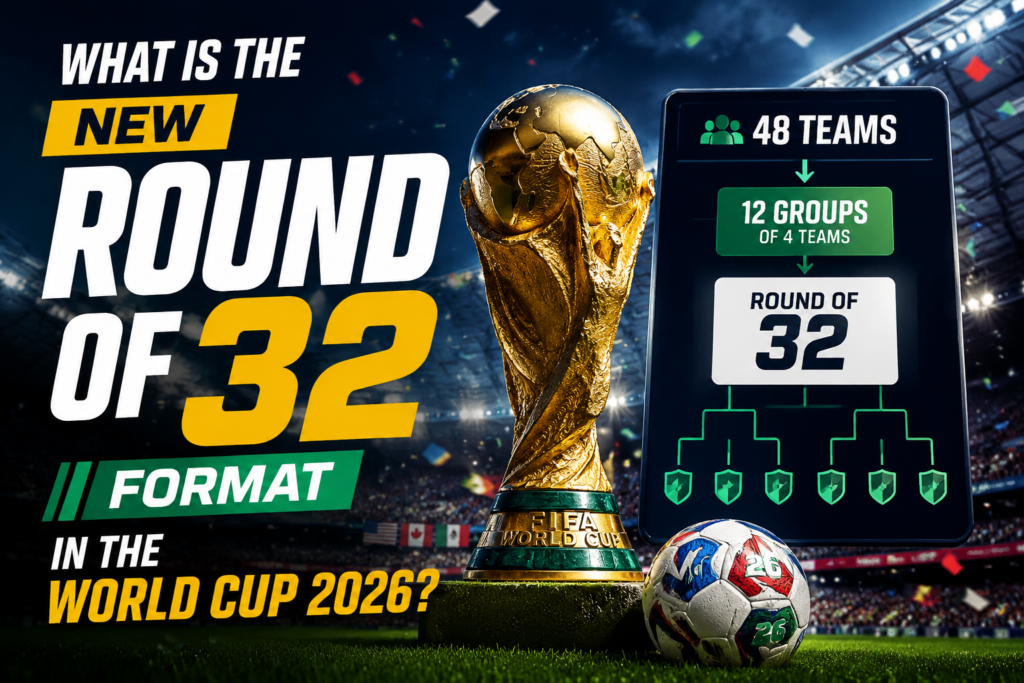
What is the New Round of 32 Format in the World Cup 2026
The 2026 World Cup introduces a revolutionary Round of 32 format featuring 48 teams divided into 12 groups of four teams each. The top two teams from each group plus the eight best third-place teams advance to a new knockout Round of 32, creating the tournament’s first-ever 32-team elimination phase before proceeding to the traditional Round of 16.
World Cup 2026 Round of 32 Format
- 48 teams total will compete in the 2026 World Cup, up from 32 teams in previous tournaments
- 12 groups of 4 teams each will play in the group stage, replacing the previous 8 groups of 4
- Top 2 teams from each group automatically advance to the Round of 32
- Best 8 third-place teams also qualify for the Round of 32 using FIFA’s ranking system
- Round of 32 is completely new – no previous World Cup has featured this elimination stage
- More matches overall with 104 total games compared to 64 in the 2022 World Cup
- Joint hosting by USA, Canada, and Mexico enables the expanded format
- Tiebreakers follow traditional FIFA rules including goal difference and goals scored
How Many Teams Are in the 2026 FIFA World Cup
The 2026 FIFA World Cup will feature 48 teams, representing a 50% increase from the traditional 32-team format used since 1998. This expansion makes it the largest World Cup in history, surpassing even the 1982 tournament which had 24 teams.
The 48-team structure allows FIFA to include more nations from each confederation:
- AFC (Asia): 8 teams (up from 4-5)
- CAF (Africa): 9 teams (up from 5)
- CONCACAF (North/Central America): 6 teams (up from 3-4)
- CONMEBOL (South America): 6 teams (up from 4-5)
- OFC (Oceania): 1 team (up from 0-1)
- UEFA (Europe): 16 teams (up from 13)
- Host nations: 3 automatic spots (USA, Canada, Mexico)
This expanded allocation gives smaller footballing nations better representation while maintaining competitive balance across all confederations.
Why Did They Change the World Cup 2026 Format to Include a Round of 32?
FIFA changed the World Cup format primarily to accommodate 48 teams while maintaining the integrity of group stage competition. The Round of 32 format solves the mathematical challenge of advancing teams from 12 groups instead of the traditional 8 groups.
Key reasons for the format change:
- Revenue generation: More matches mean increased broadcasting rights, ticket sales, and sponsorship opportunities
- Global inclusion: Allows more countries to participate, expanding FIFA’s worldwide reach
- Competitive balance: Maintains group stage excitement while creating a fair advancement system
- Host capacity: The three-nation hosting arrangement can support the additional matches and teams
The alternative formats FIFA considered included 16 groups of 3 teams, but this was rejected because it would create potential match-fixing scenarios in the final group games. The current format ensures all teams play the same number of group stage matches.
What’s Different About the 2026 World Cup Round of 32 Compared to 2022?
The 2026 World Cup Round of 32 represents a completely new tournament phase that didn’t exist in 2022 or any previous World Cup. In Qatar 2022, the top two teams from each of the 8 groups advanced directly to the Round of 16, eliminating 16 teams immediately after group play.
Major differences from 2022:
| 2022 Format | 2026 Format |
|---|---|
| 32 teams total | 48 teams total |
| 8 groups of 4 | 12 groups of 4 |
| 16 teams advance to Round of 16 | 32 teams advance to Round of 32 |
| 64 total matches | 104 total matches |
| No Round of 32 phase | New Round of 32 elimination phase |
The 2026 format essentially adds an entire knockout round, meaning teams that finish third in their groups still have a realistic chance of advancing. In 2022, third-place teams were eliminated regardless of their performance, but now the best third-place finishers get a second chance.
How Many Groups Are in the 2026 World Cup?
The 2026 World Cup features 12 groups labeled Group A through Group L, with 4 teams in each group. This represents an increase from the 8 groups used in every World Cup since 1998.
Each group follows the traditional round-robin format where every team plays every other team once, resulting in 3 matches per team in the group stage. The 12-group structure creates exactly 36 group stage matches (12 groups × 3 matches per group).
Groups Are in the 2026 World Cup
- 1st place teams: All 12 group winners advance automatically
- 2nd place teams: All 12 group runners-up advance automatically
- 3rd place teams: The 8 best third-place teams advance based on FIFA’s ranking criteria
This system ensures that 32 teams total advance from the 48-team group stage, creating a perfect bracket for the knockout rounds.
Does Every Team Play the Same Number of Matches in the Round of 32?
No, teams will not play the same total number of matches due to the expanded format and new Round of 32 phase. The minimum and maximum number of matches varies significantly based on how far each team advances.
Match totals by tournament progression:
- Group stage elimination: 3 matches (teams finishing 4th in groups or worst third-place teams)
- Round of 32 elimination: 4 matches (teams eliminated in the new Round of 32)
- Round of 16 elimination: 5 matches
- Quarter-final elimination: 6 matches
- Semi-final elimination: 7 matches
- Final runner-up: 8 matches
- Tournament winner: 8 matches
This creates a wider range of match totals compared to previous World Cups, where eliminated group stage teams played 3 matches and the winner played 7. The new format means some teams could play 5 more matches than others.
Which Countries Qualify for the 2026 World Cup Round of 32
Countries qualify for the Round of 32 by finishing in the top two positions of their group or by being one of the eight best third-place teams across all 12 groups. The qualification process involves both automatic advancement and competitive ranking.
Automatic qualifiers (24 teams):
- All 12 group winners
- All 12 group runners-up
Competitive qualifiers (8 teams):
The 8 best third-place teams are determined using FIFA’s standard criteria in this order:
- Points earned in group stage matches
- Goal difference (goals scored minus goals conceded)
- Total goals scored in group stage
- Fair play points (disciplinary record)
- FIFA ranking at tournament draw (if still tied)
This system ensures that strong teams having a difficult group still have a realistic path to the knockout stages, unlike previous World Cups where third-place teams were automatically eliminated regardless of performance quality.
How Do Tiebreakers Work in the 2026 World Cup Group Stage?
Tiebreakers in the 2026 World Cup group stage follow FIFA’s established hierarchy, applied first to determine group positions, then separately to rank third-place teams for Round of 32 qualification.
Group position tiebreakers (when teams have equal points):
- Head-to-head record between tied teams
- Goal difference in head-to-head matches between tied teams
- Goals scored in head-to-head matches between tied teams
- Overall goal difference in all group matches
- Overall goals scored in all group matches
- Fair play points (yellow cards = -1, indirect red = -3, direct red = -4, yellow + red = -5)
- FIFA ranking at the time of the tournament draw
Third-place team ranking tiebreakers:
Since third-place teams from different groups haven’t played each other, only overall statistics and fair play records are used, skipping the head-to-head criteria entirely.
The fair play tiebreaker has decided advancement in previous tournaments, making disciplinary conduct strategically important beyond just avoiding suspensions.
What Happens After the Round of 32 in the 2026 World Cup Bracket?
After the Round of 32, the 2026 World Cup follows a traditional single-elimination knockout format identical to previous tournaments, just with more teams in the earlier rounds.
Knockout stage progression:
- Round of 32: 32 teams → 16 teams (16 matches)
- Round of 16: 16 teams → 8 teams (8 matches)
- Quarter-finals: 8 teams → 4 teams (4 matches)
- Semi-finals: 4 teams → 2 teams (2 matches)
- Third-place playoff: 1 match
- Final: 1 match
Each knockout match follows FIFA’s standard format: 90 minutes of regular time, 30 minutes of extra time if tied, then a penalty shootout if still tied. No golden goal or other alternative rules apply.
The World Cup 2026 Bracket Format will be structured to ensure geographic diversity and avoid confederation matchups where possible in early knockout rounds, though this becomes impossible to maintain in later stages.
What Are the Most Common Complaints About the New 2026 World Cup Format?
Critics have raised several concerns about the expanded 48-team format and new Round of 32, focusing on competitive quality, logistical challenges, and tournament tradition.
Primary criticisms include:
Quality dilution concerns: Adding 16 more teams potentially includes nations that wouldn’t compete at the highest level, possibly leading to more lopsided group stage matches.
Tournament length issues: The expanded format extends the tournament duration and increases player fatigue, particularly affecting teams that advance deep into the knockout stages.
Complexity for fans: The third-place team ranking system creates confusion about which teams advance, unlike the straightforward top-2 advancement in previous formats.
Logistical strain: More teams require additional venues, training facilities, and accommodation across three host countries, potentially impacting the fan experience.
Tradition disruption: Purists argue the 32-team format was perfectly balanced and didn’t need changing, viewing expansion as prioritizing revenue over sporting integrity.
However, supporters counter that increased global representation and more knockout drama outweigh these concerns, particularly for developing football nations gaining their first World Cup opportunities.
How Does the Round of 32 Impact Tournament Strategy?
The new Round of 32 fundamentally changes team strategy throughout the group stage, as finishing third in a group no longer guarantees elimination. This creates different risk calculations for coaches and players.
Strategic implications:
Group stage approach
Teams may take more risks in their final group match, knowing that a strong third-place finish could still advance them. Previously, teams facing elimination would often play defensively to avoid heavy defeats.
Squad rotation
Coaches must balance resting key players against securing the best possible group position, as seeding in the Round of 32 could determine easier or harder knockout opponents.
Third-place calculations
Teams need to monitor other groups’ results to understand what point totals and goal differences typically secure advancement as third-place teams.
Knockout preparation
More teams must prepare for knockout football, requiring different tactical approaches than group stage play.
The format rewards consistent performance across all three group matches rather than just avoiding elimination, potentially leading to more attacking football as teams chase the goal difference that could prove crucial for third-place advancement.
How many total matches will be played in the 2026 World Cup?
The 2026 World Cup will feature 104 total matches: 36 in the group stage (12 groups × 3 matches each) and 68 in the knockout phases (32 + 16 + 8 + 4 + 2 + 1 + 1 for third place).
Can teams from the same group meet again in the Round of 32?
No, the Round of 32 bracket will be structured so teams from the same group are placed in different sections and cannot meet until at least the Round of 16.
What happens if multiple third-place teams are tied on all tiebreaker criteria
If teams remain tied after all standard tiebreakers, FIFA will use the teams’ official FIFA ranking at the time of the tournament draw as the final determining factor.
Will the Round of 32 matches be single elimination?
Yes, all knockout stage matches including the Round of 32 are single elimination with extra time and penalty shootouts if needed.
How long will the 2026 World Cup last compared to previous tournaments?
The 2026 World Cup will last approximately 39 days compared to 29 days for recent 32-team tournaments, due to the additional matches and teams requiring more rest days.
Are there any advantages to finishing first vs second in a group?
Yes, group winners will face third-place teams in the Round of 32, while group runners-up will face other group runners-up, theoretically providing easier matchups for group winners.
Will extra time be played in Round of 32 matches?
Yes, Round of 32 matches tied after 90 minutes will have 30 minutes of extra time, followed by a penalty shootout if still tied.
How will FIFA seed teams for the Round of 32 bracket?
FIFA will likely seed teams based on their group stage performance and FIFA rankings, similar to current tournament practices, though specific seeding criteria haven’t been finalized.
Can a team that loses all three group matches still advance?
Technically possible but extremely unlikely, as a team with zero points would need all other third-place teams to perform worse, which is mathematically improbable.
Will the Round of 32 be played at the same venues as group stages?
The Round of 32 will use a combination of group stage venues and potentially additional stadiums across the USA, Canada, and Mexico, depending on the final FIFA World Cup 2026 schedule.
How does the new format affect smaller nations’ chances?
Smaller nations benefit significantly, as more qualification spots are available and the third-place advancement system provides additional opportunities to reach knockout stages.
Will there be more rest days between matches in 2026?
FIFA has indicated that rest periods between matches will be maintained at current standards despite the expanded format, though the overall tournament duration will increase.
Conclusion
The new Round of 32 format in the World Cup 2026 represents the most significant tournament structure change in decades, transforming how teams approach group stage play and creating unprecedented opportunities for global participation. With 48 teams competing across 12 groups and 32 teams advancing to knockout play, the format balances increased inclusion with competitive integrity.
Understanding this new system is crucial for fans planning to follow the tournament, whether through comprehensive TV coverage or attending matches across the three host nations. The format rewards consistent group stage performance while providing redemption opportunities for strong teams that struggle in difficult groups.
As the tournament approaches, teams worldwide are already adapting their strategies to maximize their chances under these new rules. The expanded format promises more drama, more nations represented, and more knockout football than ever before, setting the stage for what could be the most inclusive and exciting World Cup in history.
For the latest updates on tournament preparations and viewing options, explore our complete guide to everything you need to know about FIFA World Cup 2026.