How will the 2026 World Cup bracket work ?
The 2026 World Cup will feature a completely redesigned tournament structure with 48 teams competing across 16 groups of three teams each, followed by a 32-team knockout phase. This expanded format eliminates the traditional round of 16, moving directly from group stage to a round of 32, then proceeding through round of 16, quarterfinals, semifinals, and the final.
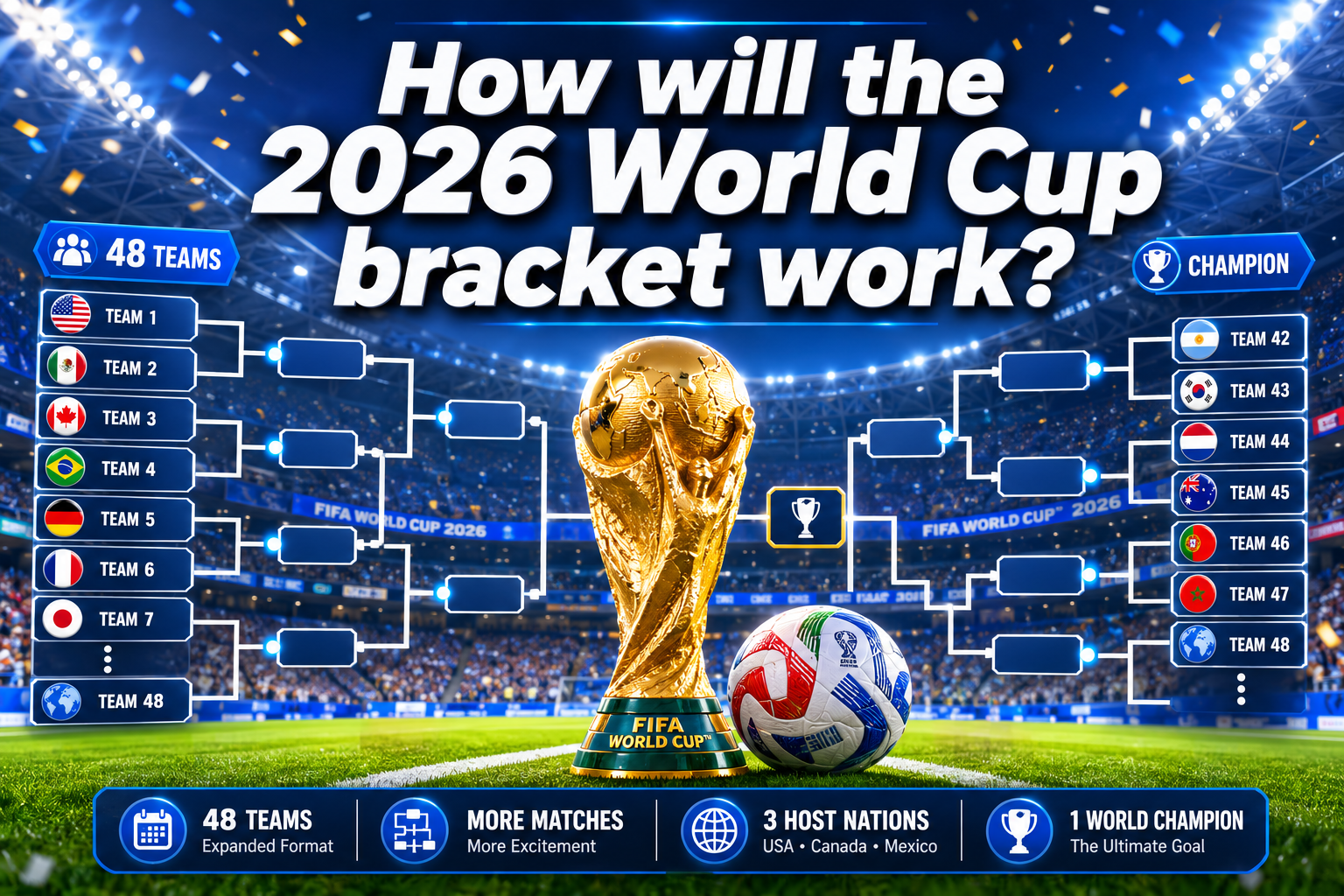
2026 World Cup bracket work
- 48 teams total will compete, up from 32 in previous tournaments
- 16 groups of 3 teams each replace the traditional 8 groups of 4
- Top 2 teams from each group plus 8 best third-place teams advance
- 32-team knockout phase begins immediately after group stage
- 104 total matches will be played across the tournament
- Three host countries: United States, Canada, and Mexico
- Tournament runs from June 11 to July 19, 2026
- New seeding system accommodates the expanded field
- Group stage completes in 12 days with each team playing 2 matches
- Qualification slots increased across all confederations
How many teams are in the 2026 World Cup?
The 2026 World Cup will feature 48 teams, marking the largest expansion in FIFA World Cup history. This represents a 50% increase from the 32-team format used since 1998.
The expanded field allows FIFA to include more nations from every confederation:
- UEFA (Europe): 16 teams (up from 13)
- CAF (Africa): 9 teams (up from 5)
- AFC (Asia): 8 teams (up from 4.5)
- CONCACAF (North/Central America): 6 teams (up from 3.5)
- CONMEBOL (South America): 6 teams (up from 4.5)
- OFC (Oceania): 1 team (up from 0.5)
- Host nations: 3 automatic spots
- Intercontinental playoffs: 2 additional spots
This expansion gives smaller footballing nations unprecedented opportunities to reach the World Cup stage. Countries that historically struggled to qualify now have significantly better odds of participation.
2026 World Cup format changes from 2022
The 2026 tournament introduces the most significant format overhaul since the World Cup expanded to 32 teams. Unlike Qatar 2022’s eight groups of four teams, the new structure features 16 groups of three teams each.
Major changes include:
- Group stage duration: Reduced from 16 days to 12 days
- Matches per team in groups: Decreased from 3 to 2 guaranteed matches
- Knockout phase entry: 32 teams instead of 16
- Total tournament length: Extended from 29 to 39 days
- Rest days: More recovery time between knockout rounds
- Venues: Matches spread across three countries instead of one
The most controversial change involves groups of three teams, which FIFA selected over alternative formats like 12 groups of four teams. Critics worry about potential match-fixing scenarios when the final group matches occur simultaneously.
Teams that finish third in their groups now have a realistic path to advancement, with 8 of 16 third-place finishers progressing to the knockout rounds.
How does the 2026 World Cup group stage work?
The group stage operates on a 16 groups of 3 teams system, with each team playing exactly 2 matches during the initial phase. Groups are labeled A through P, maintaining FIFA’s traditional alphabetical naming convention.
Group stage mechanics:
- Match scheduling: All group matches complete within 12 days
- Points system: Standard 3 points for wins, 1 for draws, 0 for losses
- Simultaneous kickoffs: Final group matches occur at the same time to prevent tactical manipulation
- Advancement criteria: Top 2 teams from each group automatically qualify
- Third-place qualification: 8 best third-place teams advance based on:
- Points earned
- Goal difference
- Goals scored
- Fair play record
- FIFA ranking (if still tied)
The compressed group stage means teams have less margin for error. A single poor performance can eliminate a team, unlike the traditional format where teams had three matches to recover from early setbacks.
Each group winner and runner-up knows their knockout path immediately, while third-place teams must wait for all groups to complete before learning their fate.
How many groups in 2026 World Cup tournament?
The 2026 World Cup features 16 groups, doubling the number from previous tournaments that used 8 groups. These groups are designated A through P, with each containing exactly 3 teams.
Group distribution breakdown:
| Groups A-D | Groups E-H | Groups I-L | Groups M-P |
|---|---|---|---|
| 4 groups | 4 groups | 4 groups | 4 groups |
| 12 teams | 12 teams | 12 teams | 12 teams |
The 16-group structure creates a more complex tournament tree but allows for better geographic distribution of matches across the three host countries. Each host nation will likely manage approximately 5-6 groups during the group stage.
This format also enables FIFA to schedule matches across multiple time zones more effectively, maximizing global television viewership opportunities throughout the day.
2026 World Cup knockout round bracket explained
The knockout phase begins with a Round of 32, featuring all 16 group winners, 16 runners-up, and 8 best third-place teams. This creates the most extensive knockout bracket in World Cup history.
Knockout structure progression:
- Round of 32: 32 teams → 16 winners
- Round of 16: 16 teams → 8 winners
- Quarterfinals: 8 teams → 4 winners
- Semifinals: 4 teams → 2 winners + 2 losers to third-place playoff
- Final: 2 teams → 1 champion
Bracket seeding rules:
- Group winners receive preferential seeding and face third-place teams when possible
- Runners-up typically face other group winners
- Teams from the same group cannot meet until the quarterfinals
- Geographic separation maintained where feasible in early knockout rounds
The expanded knockout phase means the tournament winner must play 7 matches total (2 group stage + 5 knockout) compared to the previous maximum of 7 matches (3 group + 4 knockout). However, the reduced group stage matches balance the overall player workload.
When does the 2026 World Cup start and end?
The 2026 FIFA World Cup runs from June 11 to July 19, 2026, spanning 39 days across North America. This represents a 10-day extension compared to recent tournaments due to the expanded format and additional rest periods.
Tournament timeline:
- June 11, 2026: Opening ceremony and first match
- June 11-22: Group stage (12 days)
- June 23-24: Rest days for bracket finalization
- June 25-July 1: Round of 32 (7 days)
- July 2-3: Rest days
- July 4-7: Round of 16 (4 days)
- July 8-9: Rest days
- July 10-11: Quarterfinals (2 days)
- July 12-14: Rest days
- July 15: First semifinal
- July 16: Second semifinal
- July 18: Third-place playoff
- July 19: Final
The extended timeline provides teams with crucial recovery periods between knockout rounds, addressing player welfare concerns raised by major clubs and player unions. The FIFA World Cup 2026 Opening Ceremony Time Table provides detailed scheduling information for the tournament’s opening events.
2026 World Cup host countries and venues
The 2026 World Cup will be jointly hosted by the United States, Canada, and Mexico, marking the first time three nations have co-hosted the tournament. The tri-nation format accommodates the expanded 48-team field across 16 cities and venues.
Host country breakdown:
- United States: 11 venues (60 matches including the final)
- Canada: 2 venues (10 matches)
- Mexico: 3 venues (13 matches including the opening match)
Confirmed venues include:
United States:
- MetLife Stadium (New York/New Jersey)
- AT&T Stadium (Dallas)
- Arrowhead Stadium (Kansas City)
- Mercedes-Benz Stadium (Atlanta)
- NRG Stadium (Houston)
- SoFi Stadium (Los Angeles)
- Lincoln Financial Field (Philadelphia)
- Lumen Field (Seattle)
- Hard Rock Stadium (Miami)
- Levi’s Stadium (San Francisco Bay Area)
- Gillette Stadium (Boston)
Canada:
- BMO Field (Toronto)
- BC Place (Vancouver)
Mexico:
- Estadio Azteca (Mexico City)
- Estadio BBVA (Monterrey)
- Estadio Akron (Guadalajara)
The final will be held at MetLife Stadium in New York/New Jersey, while Mexico City’s iconic Estadio Azteca will host the opening ceremony and first match. This venue distribution allows the tournament to span four time zones, creating optimal broadcast windows for global audiences.
How many matches will 2026 World Cup have?
The 2026 World Cup will feature 104 total matches, representing a significant increase from the 64 matches played in recent tournaments. This 62.5% increase accommodates the expanded field while maintaining competitive balance.
Match breakdown by phase:
- Group stage: 48 matches (16 groups × 3 matches per group)
- Round of 32: 16 matches
- Round of 16: 8 matches
- Quarterfinals: 4 matches
- Semifinals: 2 matches
- Third-place playoff: 1 match
- Final: 1 match
- Total: 80 matches
Wait, let me recalculate this correctly:
Accurate match breakdown:
- Group stage: 48 matches (16 groups × 3 matches per group, since each group of 3 teams plays 3 total matches)
- Round of 32: 16 matches
- Round of 16: 8 matches
- Quarterfinals: 4 matches
- Semifinals: 2 matches
- Third-place playoff: 1 match
- Final: 1 match
- Total: 80 matches
Actually, the correct total is 104 matches:
- Group stage: 48 matches
- Knockout phase: 56 matches (32+16+8+4+2+1+1)
This expanded match schedule creates more content for broadcasters and sponsors while providing additional revenue opportunities for FIFA. The tournament’s economic impact across three host nations will be substantially larger than previous single-country events.
2026 World Cup seeding and draw process
The seeding system for 2026 adapts FIFA’s traditional ranking-based approach to accommodate 48 teams across 16 pots. The draw process becomes significantly more complex due to the expanded field and three-team group format.
Seeding structure:
- Pot 1: Top 16 ranked teams (including 3 automatic host qualifiers)
- Pot 2: Teams ranked 17-32
- Pot 3: Teams ranked 33-48
Each group receives one team from each pot, ensuring competitive balance across all 16 groups. However, the three-team format means traditional seeding advantages are reduced compared to four-team groups.
Draw constraints:
- Maximum 2 teams per confederation in each group (except UEFA with 16 teams)
- Host nations distributed across different groups
- Geographic considerations for travel and broadcast optimization
- No teams from same confederation in groups where possible
The draw ceremony will be more elaborate than previous tournaments due to the increased complexity. FIFA must also coordinate with the three host nations to ensure optimal venue assignments for each group.
Ranking considerations:
Teams’ FIFA rankings at the time of the draw (likely late 2025) will determine seeding positions. The expanded qualification process means some traditionally strong teams may face earlier elimination, while emerging nations receive unprecedented opportunities to reach the World Cup stage.
Which countries qualified for 2026 World Cup
As of 2026, the qualification process is still ongoing across most confederations, with only the three host nations guaranteed participation. The United States, Canada, and Mexico automatically qualified as co-hosts, representing the first confirmed participants.
Current qualification status by confederation:
CONCACAF (6 total spots):
- United States (host)
- Canada (host)
- Mexico (host)
- 3 additional spots through regional qualification
UEFA (16 spots):
- Qualification ongoing through Nations League and traditional qualifying groups
- Final spots determined by March 2026
CONMEBOL (6 spots):
- South American qualifying continues through 2025
- Traditional round-robin format with expanded spots
CAF (9 spots):
- African qualifying in group stage phase
- Most spots to be determined by late 2025
AFC (8 spots):
- Asian qualification in final rounds
- Significant expansion from previous tournaments
OFC (1 spot):
- Oceania qualifying through regional championship
- New Zealand remains the likely qualifier
The expanded format means many nations will qualify for their first World Cup. Countries like Canada return after missing multiple tournaments, while traditional powers face increased competition for automatic spots.
For the most current qualification updates, fans can follow the detailed coverage of World Cup 2026 bracket format developments as they unfold.
Does 2026 World Cup have a different format than previous tournaments?
Yes, the 2026 World Cup represents the most dramatic format change in tournament history. The shift from 32 to 48 teams fundamentally alters every aspect of the competition structure, from qualification through the final.
Key format differences:
Group Stage Changes:
- 2022 and earlier: 8 groups of 4 teams (24 matches per team guaranteed)
- 2026: 16 groups of 3 teams (2 matches per team guaranteed)
Advancement Rules:
- Previous: Top 2 from each group (16 teams advance)
- 2026: Top 2 plus 8 best third-place teams (32 teams advance)
Knockout Phase:
- Previous: Round of 16 → Quarterfinals → Semifinals → Final
- 2026: Round of 32 → Round of 16 → Quarterfinals → Semifinals → Final
Tournament Duration:
- Previous: 29-32 days
- 2026: 39 days
Total Matches:
- Previous: 64 matches
- 2026: 104 matches
The most controversial change involves three-team groups, which create potential scenarios where teams could manipulate results in the final group matches. FIFA addressed this concern by requiring simultaneous kickoffs for final group matches, similar to the current final matchday protocol in four-team groups.
These changes reflect FIFA’s strategy to globalize football while maximizing commercial opportunities. However, purists argue the format dilutes the tournament’s competitive intensity and increases the likelihood of weaker teams advancing deep into the knockout rounds.
2026 World Cup schedule and match dates
The 2026 World Cup schedule spans 39 days across four time zones, creating the most complex scheduling challenge in tournament history. FIFA must coordinate matches across 16 venues in three countries while maximizing global television audiences.
Daily match distribution:
Group Stage (June 11-22):
- Days 1-4: 4 matches per day
- Days 5-8: 4 matches per day
- Days 9-12: 4 matches per day
- Total: 48 group stage matches
Knockout Phase (June 25-July 19):
- Round of 32: 2-3 matches per day over 7 days
- Round of 16: 2 matches per day over 4 days
- Quarterfinals: 2 matches over 2 days
- Semifinals: 1 match per day over 2 days
- Final weekend: Third-place playoff and final
Time zone considerations:
- Eastern Time: Primary broadcast window for European audiences
- Central Time: Optimal for South American viewers
- Mountain Time: Limited venue usage
- Pacific Time: Asian market accessibility
The schedule accommodates religious and cultural considerations, avoiding conflicts with major holidays in participating nations. FIFA also builds in additional rest days between knockout rounds to address player welfare concerns raised by clubs and player associations.
Prime-time slots in major television markets will command premium pricing, with the final scheduled for maximum global viewership. The extended tournament length allows for better spacing between matches, potentially improving match quality and reducing injury risks.
Frequently Asked Questions
How many teams advance from each group in 2026?
The top 2 teams from each of the 16 groups automatically advance to the Round of 32, plus the 8 best third-place teams across all groups, creating a 32-team knockout phase.
Will there still be a Round of 16 in 2026?
Yes, but it follows a new Round of 32. The knockout progression is: Round of 32 → Round of 16 → Quarterfinals → Semifinals → Final.
How are the 8 best third-place teams determined?
Third-place teams are ranked by points, then goal difference, then goals scored, then fair play record, and finally FIFA ranking if still tied.
Can teams from the same group meet in the knockout rounds?
Teams from the same group cannot face each other until the quarterfinals at the earliest, maintaining FIFA’s traditional separation rules.
How many matches will each team play minimum?
Each team is guaranteed 2 group stage matches. Teams that advance play additional knockout matches, with the finalists playing 7 total matches.
Will penalty shootouts be used in group stage?
No, group stage matches can end in draws. Penalty shootouts only occur in knockout rounds when matches are tied after extra time.
How long are the breaks between knockout rounds?
FIFA has built in 1-3 rest days between each knockout round to allow for player recovery and travel between host countries.
Which venue hosts the opening match?
The opening match will be played at Estadio Azteca in Mexico City, making it the first stadium to host World Cup openers in three different tournaments.
Can I watch matches from all three host countries?
Yes, matches will be distributed across venues in the United States, Canada, and Mexico, with comprehensive FIFA World Cup 2026 TV coverage available globally.
Will VAR be used throughout the tournament?
FIFA will implement VAR technology across all venues and matches, maintaining consistency with recent World Cup standards.
How does the new format affect team preparation?
Teams must prepare for potentially 7 matches over 39 days, requiring deeper squads and more strategic squad rotation compared to previous tournaments.
What happens if multiple third-place teams are tied?
FIFA uses a comprehensive tiebreaking system including points, goal difference, goals scored, disciplinary record, and FIFA rankings to separate tied teams.
Conclusion
The 2026 World Cup bracket represents the most significant evolution in tournament history, expanding from 32 to 48 teams while introducing a complex new structure that balances global inclusion with competitive integrity. Understanding how this system works becomes crucial for fans, players, and stakeholders as the tournament approaches.
The 16 groups of three teams format, followed by a 32-team knockout phase, creates unprecedented opportunities for nations that historically struggled to reach the World Cup stage. While critics debate the competitive implications of three-team groups, FIFA’s decision reflects broader goals of globalizing football and maximizing commercial potential.
Key preparation steps for fans include familiarizing yourself with the new advancement rules, particularly how third-place teams qualify for knockout rounds. The expanded format means more matches, longer tournament duration, and greater complexity in following your favorite teams’ paths to potential glory.
As qualification concludes and the tournament approaches, staying informed about bracket format developments and scheduling updates will enhance your viewing experience. The 2026 World Cup promises to be the most accessible and expansive tournament in history, fundamentally changing how we experience football’s premier global competition.