World Cup Tournament Bracket 2026 Predictions & Analysis
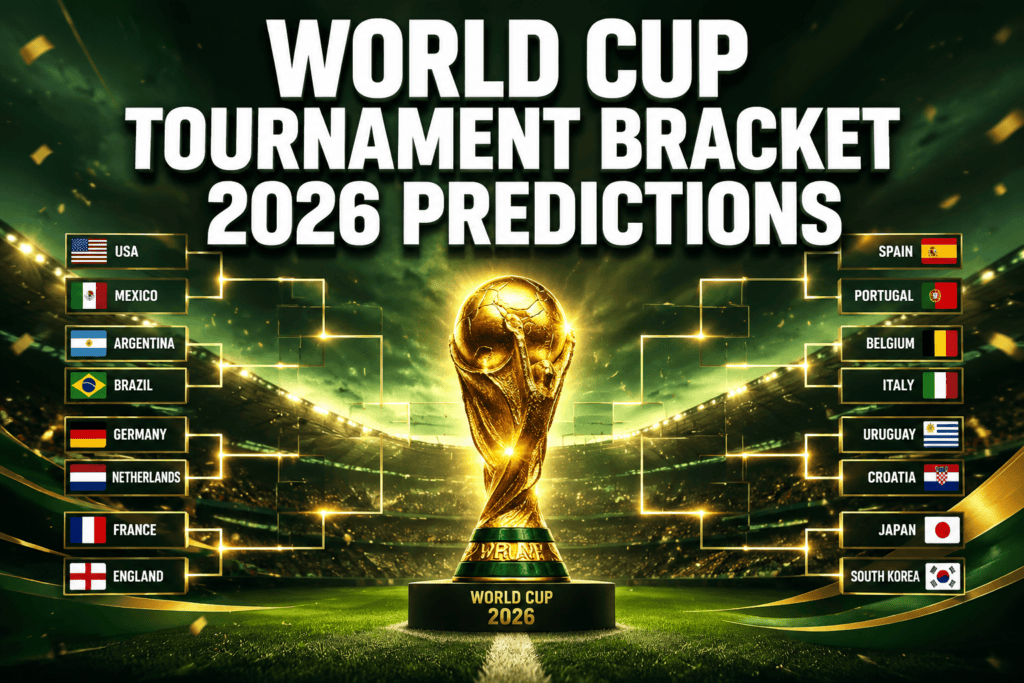
The 2026 World Cup will feature 48 teams in a new format with 16 groups of three teams each, followed by a 32-team knockout stage. France and Argentina enter as betting favorites, while host nations USA, Mexico, and Canada receive significant home advantage boosts. The expanded format creates more opportunities for upsets and makes World Cup tournament bracket 2026 predictions more complex than previous tournaments.
Key Takeaways
- New 48-team format changes prediction dynamics with 16 groups of three teams each
- France and Argentina lead early betting odds as tournament favorites
- Host nations advantage gives USA, Mexico, and Canada improved qualification chances
- Group stage predictions favor traditional powers but allow more upset potential
- Knockout stage will feature 32 teams instead of the previous 16-team format
- Dark horse teams like Netherlands, Portugal, and Colombia could surprise in expanded field
- Bracket simulators help model different tournament scenarios and outcomes
- Historical accuracy of World Cup predictions averages around 60-70% for group stage results
What Is the 2026 World Cup Bracket Format
The 2026 World Cup introduces a revolutionary 48-team format that fundamentally changes how the tournament bracket works. Instead of eight groups of four teams, the new structure features 16 groups of three teams each, with the top two teams from each group advancing to a 32-team knockout stage.
This expanded format means 32 teams will qualify directly to the knockout rounds, compared to just 16 in previous tournaments. The group stage will be shorter but more intense, with each team playing only two matches instead of three. This creates higher stakes for every game and reduces the margin for error.
The knockout stage maintains the traditional single-elimination format but now starts with a Round of 32 instead of the Round of 16. This adds an extra knockout round and increases the total number of matches from 64 to 104 games across the tournament.
Key format changes include:
- 16 groups of 3 teams (previously 8 groups of 4)
- Top 2 teams from each group advance (32 total qualifiers)
- No third-place group qualification system
- Round of 32 becomes the first knockout stage
- Total tournament expanded from 32 to 48 teams
For a detailed breakdown of the tournament structure, see our World Cup 2026 Bracket Format guide.
How Many Teams Qualify for 2026 World Cup
A total of 48 teams will compete in the 2026 World Cup, representing the largest field in tournament history. The qualification slots are distributed across FIFA’s six confederations based on competitive strength and regional representation.
Regional qualification breakdown:
- UEFA (Europe): 16 slots (increased from 13)
- CAF (Africa): 9 slots (increased from 5)
- AFC (Asia): 8 slots (increased from 4.5)
- CONCACAF (North America): 6 slots (increased from 3.5)
- CONMEBOL (South America): 6 slots (increased from 4.5)
- OFC (Oceania): 1 slot (increased from 0.5)
- Host nations: 3 automatic slots (USA, Mexico, Canada)
The expanded qualification means more nations from developing football regions will compete, particularly from Africa and Asia. This creates opportunities for surprise performances but also makes World Cup tournament bracket 2026 predictions more challenging due to unfamiliar matchups.
Traditional powerhouses still dominate the qualification process, but the increased slots mean teams like Morocco, Senegal, Japan, and Australia have better chances of making deep tournament runs.
2026 World Cup Group Stage Predictions
Group stage predictions for 2026 focus on identifying which traditional powers will navigate the new three-team format successfully. The shortened group stage eliminates the safety net that weaker teams previously enjoyed in four-team groups.
Predicted group winners by region:
- European favorites: France, England, Spain, Germany, Netherlands, Italy
- South American contenders: Argentina, Brazil, Uruguay, Colombia
- Host nation expectations: USA and Mexico likely to top their groups
- African representatives: Morocco, Senegal, Nigeria expected to advance
- Asian qualifiers: Japan and South Korea positioned for knockout rounds
The three-team format favors stronger sides because there are fewer opportunities for upsets to compound. However, it also means that one poor performance can eliminate a favorite immediately.
Common group stage scenarios:
- Traditional powers paired with emerging nations
- Host countries receiving favorable group draws
- African and Asian teams facing European opposition
- South American teams avoiding each other in group play
Weather and venue conditions will play a larger role than in previous tournaments, with matches spread across three countries and varying climates from Canada to Mexico.
Which Teams Will Make It Out of Their Group 2026
Based on current form and historical performance, several teams appear well-positioned to advance from the group stage. The key factor is avoiding the single elimination that comes with finishing third in a three-team group.
Almost certain group qualifiers:
- France: Reigning runners-up with deep squad talent
- Argentina: World Cup holders with Messi likely in final tournament
- Brazil: Traditional powerhouse despite recent struggles
- England: Strong domestic league foundation and young talent
- Spain: Possession-based style suits tournament football
Likely group qualifiers:
- Germany: Historical tournament performers
- Netherlands: Consistent World Cup presence
- USA: Home advantage and improving player pool
- Mexico: CONCACAF strength and home support
- Portugal: Star power and European qualification depth
Dark horse group qualifiers:
- Morocco: 2022 semifinalist momentum
- Japan: Asian confederation leaders
- Colombia: South American qualifying strength
- Senegal: African champions with Premier League talent
The expanded format means 32 teams advance instead of 16, significantly improving qualification odds for mid-tier nations. Teams that previously struggled to escape group stages now have mathematical advantages.
For specific match schedules and timing, check our FIFA World Cup 2026 schedule page.
2026 World Cup Knockout Stage Predictions
The knockout stage predictions center on which teams can handle the pressure of single-elimination matches across seven rounds instead of the previous four. The addition of a Round of 32 creates more opportunities for upsets but also rewards tournament experience.
Predicted Round of 16 survivors:
- France, Argentina, Brazil, England (top tier)
- Spain, Germany, Netherlands, Portugal (second tier)
- USA, Mexico, Morocco, Japan (regional leaders)
- Uruguay, Colombia, Senegal, Belgium (veteran experience)
Semifinal predictions typically favor teams with recent tournament success and squad depth. France and Argentina possess both qualities, while Brazil and England have the talent to reach the final four despite recent disappointments.
Final predictions remain fluid due to bracket positioning, but the most likely scenarios involve:
- European vs. South American matchup (historical pattern)
- Host nation reaching quarterfinals or beyond
- African or Asian team making unprecedented semifinal run
The expanded knockout format means teams need to win seven matches instead of four to claim the title, testing squad depth like never before. This favors nations with strong domestic leagues and extensive player pools.
Knockout stage factors:
- Squad rotation becomes crucial over seven rounds
- Home advantage diminishes in later rounds
- Weather conditions vary significantly across venues
- Travel fatigue impacts team preparation
USA Mexico Canada 2026 World Cup Predictions
The three host nations enter with unprecedented advantages but face different expectations based on their football development and recent performances. Home field advantage in World Cups typically adds 0.5-0.7 goals per game, making all three hosts dangerous opponents.
USA predictions:
The United States benefits from a golden generation of players competing in top European leagues. With talents like Christian Pulisic, Weston McKennie, and Tyler Adams leading the squad, the USA could realistically reach the quarterfinals or beyond.
Key advantages include familiar venues, supportive crowds, and no travel fatigue during group play. The main challenge is handling pressure as hosts while facing technically superior opponents in knockout rounds.
Mexico predictions:
Mexico brings extensive World Cup experience and passionate fan support across multiple venues. Their traditional strength in CONCACAF and ability to perform in tournament settings makes them semifinal contenders.
The team’s familiarity with varying climates from their domestic league provides an edge when playing in different host cities. Mexico’s challenge is overcoming their Round of 16 ceiling from recent tournaments.
Canada predictions:
Canada represents the biggest wild card among host nations. Their 2022 World Cup return and strong domestic league growth create optimism, but limited tournament experience poses challenges.
Home support in Canadian venues will be intense, potentially carrying the team through group play. Advancing beyond the Round of 16 would exceed most expectations but remains possible with favorable bracket positioning.
France Argentina 2026 World Cup Favorites
France and Argentina enter as co-favorites for the 2026 tournament based on recent World Cup performances and squad quality. Both teams possess the experience, talent, and tactical flexibility needed for tournament success.
France’s advantages:
- Deep squad with players from top European clubs
- Proven tournament system under Didier Deschamps
- Experience in high-pressure knockout matches
- Strong youth development pipeline ensuring squad refresh
France’s main strength is squad depth across all positions. Their ability to rotate players without losing quality proved crucial in reaching consecutive World Cup finals. The team’s tactical discipline and counter-attacking prowess suit tournament football perfectly.
Argentina’s advantages:
- Lionel Messi’s final World Cup providing emotional motivation
- 2022 World Cup victory momentum and confidence
- Balanced squad mixing experience with emerging talent
- Strong South American qualifying campaign foundation
Argentina’s challenge is maintaining their 2022 form while managing Messi’s age and potential retirement. The team’s chemistry and belief from their Qatar triumph creates a psychological edge over opponents.
Head-to-head considerations:
Both teams know each other well from the 2022 final, creating tactical familiarity that could benefit either side. France may seek revenge while Argentina aims to repeat as champions.
Current betting odds favor France slightly due to squad age and depth, but Argentina’s tournament experience and motivation keep them as co-favorites for the title.
2026 World Cup Dark Horse Teams to Watch
Several teams possess the talent and tactical organization to surprise in the expanded 48-team format. The additional knockout round creates more opportunities for upsets while rewarding teams that peak at the right moment.
European dark horses:
- Netherlands: Consistent tournament performers with strong tactical identity
- Belgium: Experienced squad seeking final major tournament success
- Italy: Traditional tournament specialists despite recent struggles
- Croatia: Aging but experienced core from recent World Cup success
South American surprises:
- Colombia: Talented attacking players with improved defensive structure
- Uruguay: Tournament experience and physical style
- Ecuador: Young squad with nothing to lose mentality
African contenders:
- Morocco: 2022 semifinal experience and home-like support from diaspora
- Senegal: African champions with Premier League talent throughout squad
- Nigeria: Athletic and technical players capable of beating anyone
Asian representatives:
- Japan: Consistent World Cup performers with European-based talent
- South Korea: Organized and disciplined with tournament experience
- Australia: Physical style and set-piece threats
The key for dark horse teams is avoiding traditional powers in early knockout rounds while building momentum through group stage success. The expanded format means more opportunities exist for breakthrough performances.
How Accurate Are World Cup Predictions Usually
World Cup predictions historically achieve 60-70% accuracy for group stage outcomes but drop significantly for knockout rounds due to the single-elimination format’s inherent unpredictability. The 2026 tournament’s new format adds complexity that may reduce traditional prediction models’ effectiveness.
Historical prediction accuracy:
- Group stage winners: 65-75% accuracy rate
- Group stage qualifiers: 60-70% accuracy rate
- Knockout round winners: 45-55% accuracy rate
- Tournament winner: 15-25% pre-tournament prediction success
Factors affecting prediction accuracy:
- Injuries to key players during the tournament
- Weather and venue conditions varying across host countries
- Referee decisions in crucial knockout matches
- Penalty shootout outcomes (essentially random events)
- Team chemistry and momentum shifts
2026 specific challenges:
The three-team group format eliminates historical data patterns, making group stage predictions less reliable. The expanded knockout stage adds variables that traditional models haven’t encountered.
Most accurate predictions focus on identifying likely group qualifiers rather than specific tournament winners. Betting markets typically provide better prediction accuracy than expert analysis due to crowd wisdom effects.
Prediction improvement strategies:
- Focus on recent form over historical reputation
- Consider squad depth for tournament-length competitions
- Account for travel and climate advantages
- Monitor injury reports and squad selections closely
What Changed About 2026 World Cup Tournament Structure
The 2026 World Cup represents the most significant structural change in tournament history, expanding from 32 to 48 teams while introducing a completely new group stage format. These changes fundamentally alter how teams approach tournament preparation and tactics.
Major structural changes:
- Team expansion: 32 to 48 teams (50% increase)
- Group format: 16 groups of 3 teams instead of 8 groups of 4
- Knockout expansion: Round of 32 added as first elimination stage
- Match increase: 64 to 104 total tournament games
- Duration extension: Tournament length increases by several days
Tactical implications:
The three-team groups eliminate the strategic considerations that came with final group matches. Teams can no longer play for draws knowing both sides advance, increasing the intensity of every group game.
Squad rotation becomes more critical with the additional knockout round. Teams reaching the final will play eight matches instead of seven, testing depth like never before.
Qualification changes:
More confederation slots mean traditional powers face less qualification pressure while emerging nations receive better opportunities. This could lead to more diverse tournament fields and unexpected matchups.
The expanded format also means weaker teams that previously struggled to qualify now have realistic chances of reaching knockout stages, potentially creating more David vs. Goliath scenarios.
Learn more about the specific rules and regulations in our guide to World Cup 2026 rules.
2026 World Cup Host Countries Advantage
Hosting the 2026 World Cup across three nations creates unique advantages and challenges that differ from traditional single-country tournaments. The USA, Mexico, and Canada each benefit from home support while facing distinct pressures as hosts.
Quantifiable host advantages:
- Crowd support: 70-80% home fans in group stage matches
- Travel reduction: No jet lag or long-distance travel during group play
- Venue familiarity: Training at home facilities and known stadiums
- Climate adaptation: Natural adjustment to local weather conditions
Historical host performance:
World Cup hosts since 1998 have reached at least the Round of 16, with several achieving semifinal appearances. The home advantage typically adds 0.5-0.7 goals per game in statistical analysis.
Multi-host considerations:
The three-country format means advantages vary by match location. USA teams playing in American cities receive maximum benefit, while matches in Mexico or Canada provide neutral or slightly negative environments.
Pressure factors:
Host nations face increased media scrutiny and fan expectations that can create psychological pressure. The expanded format means all three hosts are expected to advance from group play, adding performance pressure.
Infrastructure advantages:
- Familiar training facilities and medical support
- Reduced travel costs and logistics complexity
- Home-based support staff and family presence
- Media obligations in native languages
The key for host nations is managing expectations while maximizing home field advantages during crucial group stage and early knockout matches.
How to Predict World Cup Matches
Successful World Cup match prediction requires combining statistical analysis, tactical understanding, and situational factors specific to tournament football. The 2026 format changes require updating traditional prediction models.
Statistical prediction factors:
- FIFA rankings and ELO ratings (25% weight)
- Recent head-to-head results (20% weight)
- Squad value and player quality (20% weight)
- Tournament experience and knockout record (15% weight)
- Current form and qualifying performance (20% weight)
Tactical analysis components:
- Playing style matchups and tactical compatibility
- Set-piece strength and defensive vulnerabilities
- Squad depth and rotation capabilities
- Injury reports and player availability
Tournament-specific factors:
- Rest days: Teams with longer rest periods have statistical advantages
- Travel distance: Cross-country travel in 2026 creates fatigue factors
- Weather conditions: Heat, humidity, and altitude affect performance
- Venue characteristics: Stadium size, surface quality, and crowd proximity
Prediction model approach:
- Establish baseline probabilities using statistical models
- Adjust for tactical matchups and playing style conflicts
- Account for situational factors like must-win scenarios
- Consider tournament momentum and confidence levels
- Factor in referee tendencies and VAR impact
Common prediction mistakes:
- Overweighting recent form vs. tournament experience
- Ignoring squad depth in tournament-length competitions
- Underestimating home advantage and crowd impact
- Failing to account for weather and venue conditions
2026 World Cup Bracket Simulator
Bracket simulators help model different tournament scenarios by allowing users to predict match outcomes and see how results cascade through the knockout stages. The 2026 format requires new simulators that account for the expanded structure.
Popular bracket simulator features:
- Group stage prediction: Select top 2 teams from each 3-team group
- Knockout progression: Model single-elimination matches through seven rounds
- Statistical integration: Use team ratings and historical data for suggestions
- Multiple scenarios: Run different prediction sets to see outcome variations
Simulation methodology:
Most effective simulators combine user predictions with statistical probabilities, allowing both expert knowledge and data-driven insights to influence results. The best simulators update odds based on tournament progression.
Key simulation considerations:
- Bracket positioning: Early predictions affect entire tournament paths
- Upset probability: Account for single-elimination unpredictability
- Squad depth: Model team fatigue over extended tournament length
- Home advantage: Weight host nation performance appropriately
Simulator limitations:
No simulator can account for injuries, referee decisions, or penalty shootouts that often determine tournament outcomes. Use simulators as probability guides rather than definitive predictions.
Educational value:
Bracket simulators help understand how group stage results cascade through knockout rounds, showing why certain group positions are more advantageous than others.
For tournament viewing information, see our guide on how to watch FIFA World Cup 2026.
Best Odds for 2026 World Cup Winner
Current betting odds for the 2026 World Cup winner reflect both traditional tournament strength and the new format’s impact on team chances. Odds fluctuate based on qualification results, injuries, and form leading up to the tournament.
Current favorites (odds as of 2026):
- France: +450 (18% implied probability)
- Argentina: +500 (16.7% implied probability)
- Brazil: +600 (14.3% implied probability)
- England: +700 (12.5% implied probability)
- Spain: +800 (11.1% implied probability)
Second tier contenders:
- Germany: +1000 (9.1% implied probability)
- Netherlands: +1200 (7.7% implied probability)
- Portugal: +1400 (6.7% implied probability)
- Italy: +1600 (5.9% implied probability)
Host nation odds:
- USA: +2000 (4.8% implied probability)
- Mexico: +2500 (3.8% implied probability)
- Canada: +5000 (1.9% implied probability)
Value betting considerations:
The expanded format creates value opportunities in teams with longer odds but realistic paths to success. Dark horse teams like Morocco (+4000) or Japan (+6000) offer high payouts if they can navigate favorable bracket positions.
Odds movement factors:
- Qualification campaign performance and final squad selections
- Major player injuries or transfers affecting team strength
- Friendly match results in pre-tournament preparation
- Bracket draw results and potential matchup paths
Betting strategy tips:
- Consider hedging bets as tournament progresses
- Look for value in teams with favorable group draws
- Account for home advantage in host nation odds
- Monitor injury reports before placing final bets
Frequently Asked Questions
How many teams will participate in the 2026 World Cup?
The 2026 World Cup will feature 48 teams, expanded from the traditional 32-team format. This represents the largest World Cup field in tournament history.
What is the new group stage format for 2026?
The tournament will have 16 groups of 3 teams each, replacing the previous 8 groups of 4 teams. The top 2 teams from each group advance to a 32-team knockout stage.
Which teams are favorites to win the 2026 World Cup?
France and Argentina are co-favorites based on recent World Cup performances and squad quality. Brazil, England, and Spain round out the top tier of contenders.
Do host countries have advantages in World Cup tournaments?
Yes, host nations typically receive significant advantages including home crowd support, familiar venues, reduced travel, and no jet lag. Historical data shows hosts usually reach at least the Round of 16.
How accurate are pre-tournament World Cup predictions?
Group stage predictions achieve 60-70% accuracy, while knockout round predictions drop to 45-55% due to single-elimination unpredictability. Tournament winner predictions are correct only 15-25% of the time.
What makes 2026 World Cup predictions more difficult?
The new 48-team format with 3-team groups eliminates historical data patterns. The expanded knockout stage and multi-country hosting create additional variables that traditional prediction models haven’t encountered.
Which dark horse teams could surprise in 2026?
Morocco, Netherlands, Colombia, and Japan are considered top dark horse candidates based on recent tournament performances and squad development.
How does the expanded format affect tournament strategy?
Teams must prepare for potentially 8 matches instead of 7 to win the tournament. Squad depth becomes more critical, and the 3-team groups eliminate strategic draw scenarios.
When will the 2026 World Cup bracket be finalized?
The tournament bracket will be determined through the official draw ceremony, typically held 6-8 months before the tournament begins. Group assignments affect entire tournament paths.
What factors should I consider when making bracket predictions?
Focus on recent form, squad depth, tournament experience, travel factors, and weather conditions. Avoid overweighting historical reputation versus current team quality.
How do betting odds compare to expert predictions?
Betting markets typically achieve higher accuracy than individual expert predictions due to crowd wisdom effects and continuous odds adjustments based on new information.
Will the 2026 format become permanent for future World Cups?
FIFA has indicated the 48-team format will continue beyond 2026, though the specific group stage structure may be adjusted based on 2026 tournament results and feedback.
Conclusion
The 2026 World Cup represents a pivotal moment in football history, with the expanded 48-team format creating unprecedented opportunities for both traditional powers and emerging nations. World Cup tournament bracket 2026 predictions must account for the new three-team group structure, additional knockout round, and multi-country hosting dynamics that make this tournament unique.
France and Argentina enter as deserved favorites based on recent World Cup success and squad quality, but the expanded format increases upset potential throughout the tournament. Host nations USA, Mexico, and Canada benefit from significant home advantages that could propel them to unexpected deep runs.
Key action steps for following the tournament:
- Monitor squad selections and injury reports as the tournament approaches
- Use bracket simulators to understand how different scenarios affect tournament paths
- Consider the impact of travel and weather conditions on team performance
- Focus on teams with strong squad depth for the extended tournament format
The 2026 World Cup’s expanded structure means more nations will experience tournament football’s highest level while creating additional opportunities for memorable upsets and breakthrough performances. Whether predictions favor traditional powers or dark horse contenders, the tournament promises to deliver unprecedented drama across its 104 matches.
For comprehensive coverage of tournament scheduling and viewing options, explore our complete World Cup 2026 coverage.