2026 FIFA World Cup Asia: Regional Broadcast & Streaming Guide
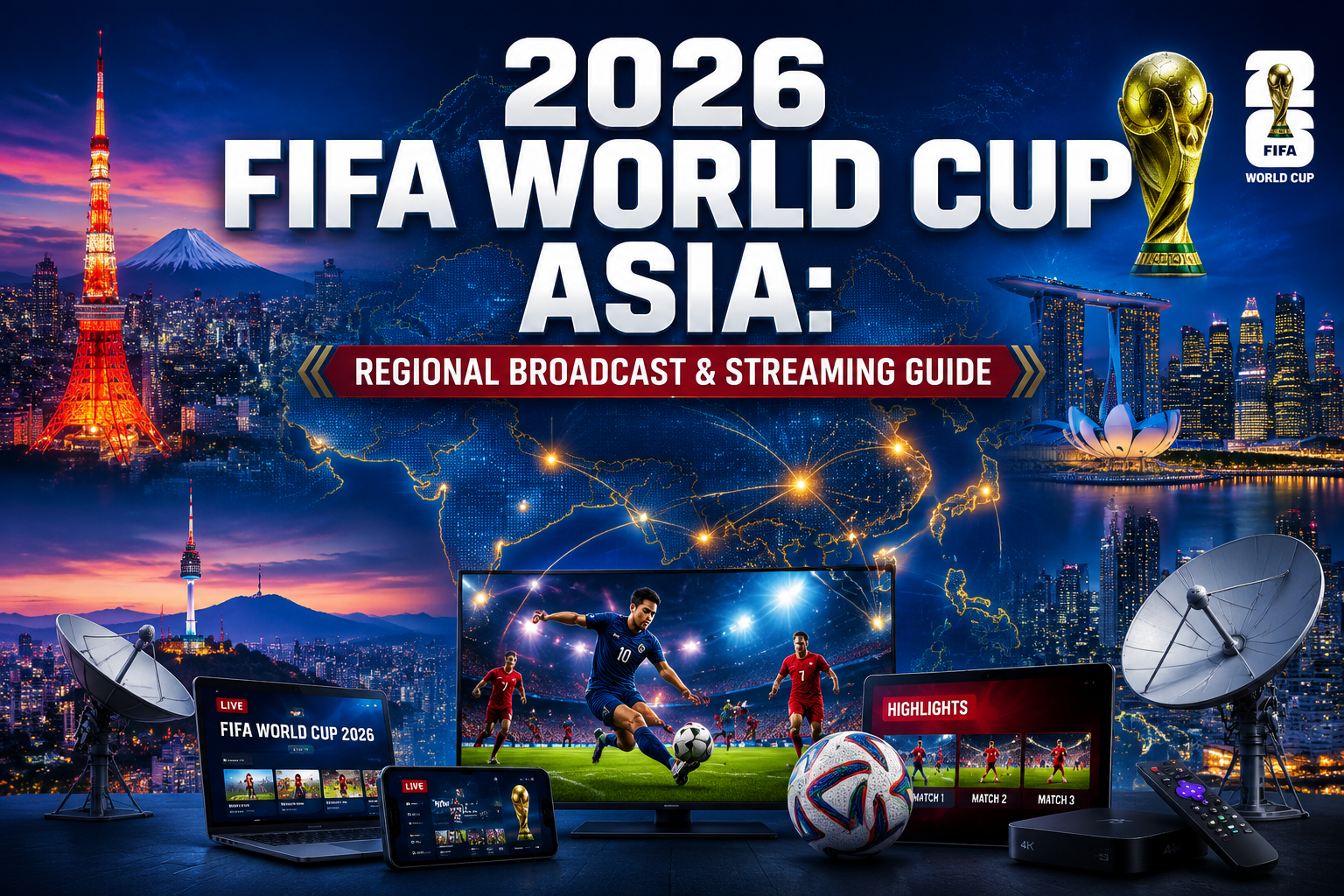
The 2026 FIFA World Cup Asia: Regional Broadcast & Streaming Guide covers official broadcasters and streaming platforms across East Asia, Southeast Asia, South Asia, and West Asia, with rights varying significantly by country. Major platforms include beIN Sports in the Middle East, Sony Sports Network in India, CCTV in China, and various national broadcasters across Japan, South Korea, and Southeast Asia. Most services require paid subscriptions ranging from $5 to $50 monthly, though some countries offer limited free-to-air coverage on state television channels.
2026 FIFA World Cup Asia Broadcast Regional
- Official broadcast rights for the 2026 FIFA World Cup vary by country, with no single pan-Asian broadcaster covering all territories
- Subscription costs range from approximately $5 per month in India to $50 monthly in Japan and South Korea for premium sports packages
- Free-to-air options exist in select countries including India (Doordarshan), Indonesia (TVRI), and several Middle Eastern nations
- Time zone differences mean Asian viewers will watch most matches during early morning hours (2 AM to 12 PM local time)
- VPN usage may violate streaming service terms and conditions, potentially resulting in account suspension
- English commentary is available on most premium platforms but may require selecting specific audio tracks
- Minimum internet speed of 10 Mbps is recommended for HD streaming, with 25 Mbps ideal for 4K broadcasts
- Geo-blocking restrictions prevent access to certain streams outside licensed territories
- Cable packages typically offer more reliable service during high-traffic events compared to streaming platforms
- Mobile streaming options are widely available but consume significant data (approximately 1-3 GB per match)
Which Countries in Asia Can Watch the 2026 World Cup Live
All Asian countries will have access to 2026 FIFA World Cup broadcasts through officially licensed broadcasters, though the specific channels and platforms differ by territory. FIFA ensures global coverage by selling regional broadcast rights to established media companies in each market.
East Asia includes Japan (NHK, Fuji TV, ABEMA), South Korea (KBS, SBS, MBC), China (CCTV, Migu Video), Taiwan (CTS), and Hong Kong (Now TV, ViuTV). These markets typically feature both free-to-air and premium subscription options.
Southeast Asia coverage spans:
- Singapore: MediaCorp, StarHub
- Malaysia: RTM, Astro
- Thailand: True Vision, Channel 7
- Indonesia: TVRI, Vidio
- Philippines: TV5, Cignal
- Vietnam: VTV, K+
South Asia relies heavily on Sony Sports Network across India, Pakistan, Bangladesh, Sri Lanka, Nepal, and Bhutan, with additional free-to-air coverage on national broadcasters like Doordarshan in India.
West Asia and Middle East predominantly features beIN Sports as the primary rights holder across UAE, Saudi Arabia, Qatar, Kuwait, Bahrain, Oman, Iraq, Jordan, and Lebanon.
One critical consideration: viewers must use services licensed for their specific country of residence. Cross-border streaming typically violates licensing agreements and may result in blocked access.
What Channels Are Broadcasting FIFA 2026 in South Korea
South Korea’s 2026 World Cup broadcasts will air across three major terrestrial networks: KBS, SBS, and MBC, all offering free-to-air coverage. These public broadcasters traditionally share World Cup rights and provide Korean-language commentary with comprehensive pre-match and post-match analysis.
Terrestrial options:
- KBS (Korean Broadcasting System): Primary public broadcaster with extensive sports coverage
- SBS (Seoul Broadcasting System): Commercial network with strong sports programming
- MBC (Munhwa Broadcasting Corporation): Public broadcaster offering alternative commentary teams
Cable and streaming alternatives:
- SPOTV: Premium sports channel available through cable packages
- Coupang Play: Streaming platform that may secure supplementary rights
- Wavve: Joint streaming service from terrestrial broadcasters offering catch-up viewing
Korean viewers benefit from one of Asia’s most comprehensive free broadcast packages, requiring only a television and antenna for full tournament access. Cable subscribers gain additional features like multi-camera angles, enhanced statistics, and on-demand replays.
Match times present challenges for Korean audiences, with most games scheduled between 2 AM and 12 PM Korea Standard Time due to the tournament’s North American location. Broadcasters typically offer both live coverage and same-day replays during prime evening hours.
For comprehensive scheduling information, check our FIFA World Cup 2026 Schedule Time Table and Group Fixtures.
How Much Do Streaming Services Cost in Japan for World Cup Matches
Japanese streaming services for the 2026 World Cup range from free options to premium packages costing approximately 4,000-6,000 yen ($28-$42) monthly. The pricing structure reflects Japan’s competitive sports broadcasting market and high production quality standards.
Free streaming options:
- NHK Plus: Free for NHK broadcast license holders (standard household TV license)
- TVer: Catch-up service for terrestrial broadcasts with limited live streaming
Paid streaming platforms:
- ABEMA Premium: Approximately 960 yen ($7) monthly, offers live sports streaming with DVR functionality
- DAZN Japan: Around 4,200 yen ($29) monthly for comprehensive sports package
- Hulu Japan: Approximately 1,026 yen ($7) monthly, may carry select matches
- WOWOW: Premium service at 2,530 yen ($18) monthly with extensive sports coverage
Cable and satellite alternatives:
- SKAPA: Sports-focused package at 4,500-6,000 yen ($31-$42) monthly
- J:COM: Regional cable provider with sports tiers starting at 3,800 yen ($26) monthly
Most Japanese services offer free trial periods of 14-31 days, allowing viewers to test streaming quality before committing. Annual subscriptions typically provide 10-15% discounts compared to monthly billing.
Japanese platforms generally deliver superior streaming quality compared to other Asian markets, with 4K broadcasts becoming standard for major sporting events. However, simultaneous viewer demand during popular matches can cause buffering on lower-tier internet connections.
Can I Watch World Cup Games for Free in Southeast Asia
Free World Cup access in Southeast Asia is available through national public broadcasters in most countries, though coverage quality and match selection vary significantly. Indonesia, Thailand, Vietnam, and the Philippines offer the most comprehensive free-to-air options.
Countries with free terrestrial coverage:
Indonesia: TVRI (national public broadcaster) provides free access to all matches with Bahasa Indonesia commentary. Signal quality varies by region, with urban areas receiving superior coverage.
Thailand: Channel 7 and Thai PBS offer select matches free-to-air, typically focusing on Thailand’s matches (if qualified) and knockout rounds. Complete tournament coverage requires True Vision subscription.
Vietnam: VTV (Vietnam Television) broadcasts most matches free-to-air across multiple channels (VTV2, VTV5, VTV6), providing one of Southeast Asia’s most generous free packages.
Philippines: TV5 offers free terrestrial coverage of select matches, with Cignal required for comprehensive tournament access.
Malaysia: RTM provides limited free-to-air coverage, primarily for Malaysia’s matches and finals. Astro subscription needed for full tournament.
Singapore: MediaCorp’s free channels offer select matches, with StarHub required for complete coverage.
Common limitations of free broadcasts:
- Lower video quality (often 720p maximum)
- Single commentary option (typically local language only)
- No DVR or replay functionality
- Limited pre-match and post-match analysis
- Potential for commercial interruptions
For viewers seeking English commentary and premium features, paid subscriptions remain necessary across Southeast Asia. However, the free options provide legitimate access for budget-conscious fans willing to accept basic viewing experiences.
Which Streaming Platforms Have World Cup Rights in China
CCTV (China Central Television) holds exclusive 2026 FIFA World Cup broadcast rights for mainland China, with distribution across both traditional television and digital platforms. This government-owned broadcaster maintains monopolistic control over major international sporting events within Chinese territory.
Primary platforms:
- CCTV-5: Main sports channel with live broadcasts
- CCTV-5+: Supplementary sports channel for simultaneous match coverage
- CCTV Video: Official streaming app and website (free with registration)
Licensed secondary platforms:
- Migu Video: China Mobile’s streaming service with CCTV partnership
- Youku: Alibaba-owned platform with potential sublicensing agreement
- Tencent Sports: May secure limited streaming rights through CCTV partnership
Chinese viewers access World Cup content free through CCTV platforms, requiring only account registration with Chinese phone number verification. The state broadcaster provides Mandarin commentary exclusively, with no English audio options on official channels.
Important restrictions:
- VPN usage to access foreign streams violates Chinese internet regulations
- International streaming services (beIN Sports, Sony Liv, etc.) are geo-blocked within China
- Unlicensed streaming sites face government blocking during major events
- Social media live streams are actively monitored and removed
CCTV’s production quality has improved substantially since 2018, now offering 4K broadcasts for major matches and comprehensive digital features including multi-angle replays and real-time statistics. The broadcaster typically assigns its most experienced commentary teams to World Cup coverage.
For Chinese viewers traveling abroad, CCTV Video’s international version may work with Chinese account credentials, though functionality varies by country.
Why Are Some Asian Countries Blocked from Certain World Cup Streams
Geo-blocking exists because FIFA sells exclusive territorial broadcast rights to different companies in each country or region, with contractual obligations requiring platforms to restrict access to licensed territories only. This system maximizes FIFA’s revenue by creating competitive bidding in each market rather than selling single pan-Asian rights.
How geo-blocking works:
Streaming platforms detect user location through IP address analysis, GPS data (on mobile apps), and payment method verification. When a user attempts to access content from outside the licensed territory, the platform denies service to comply with contractual restrictions.
Economic rationale:
A broadcaster paying $50 million for exclusive Indian rights would lose value if viewers could access cheaper subscriptions from neighboring countries. Territorial exclusivity protects these investments and justifies higher rights fees paid to FIFA.
Common blocking scenarios:
- Indian viewers cannot access beIN Sports streams licensed for Middle East
- Japanese subscribers to ABEMA cannot watch while traveling in South Korea
- Chinese CCTV streams block access from Taiwan, Hong Kong, and international locations
- Southeast Asian platforms restrict access between neighboring countries despite similar pricing
Technical enforcement methods:
- IP address geolocation databases
- Credit card billing address verification
- Mobile device GPS location checks
- Account registration requiring local phone numbers
- Periodic location re-verification during streaming
Legal implications:
Circumventing geo-blocks through VPNs or proxy servers typically violates streaming service terms of service, potentially resulting in account suspension or termination. While enforcement varies by platform, major broadcasters increasingly employ sophisticated VPN detection systems.
The fragmented rights structure frustrates viewers but remains FIFA’s preferred model, generating substantially higher total revenue than single-region licensing would produce. This approach is unlikely to change for the 2026 tournament despite growing consumer demand for borderless streaming access.
Difference Between Cable and Online World Cup Broadcast Options
Cable television delivers World Cup broadcasts through dedicated physical infrastructure (coaxial or fiber-optic cables), while online streaming transmits the same content via internet protocols over any broadband connection. Each approach offers distinct advantages depending on viewer priorities and local infrastructure quality.
Cable broadcast advantages:
- Reliability during peak demand: Cable systems dedicate bandwidth to television signals, preventing the buffering issues that plague streaming platforms when millions watch simultaneously
- Consistent quality: Video quality remains stable regardless of household internet activity
- Lower latency: Cable broadcasts typically run 10-45 seconds ahead of streaming equivalents
- No data caps: Watching on cable doesn’t consume internet data allowances
- Better for older TVs: Direct connection without requiring smart TV features or external devices
Online streaming advantages:
- Device flexibility: Watch on smartphones, tablets, laptops, or smart TVs from any location with internet
- No installation required: Immediate access without technician visits or equipment rental
- DVR functionality: Most services include cloud recording and pause/rewind features
- Multi-screen viewing: Watch different matches simultaneously on multiple devices
- Cost efficiency: Often cheaper than cable packages, especially for short-term subscriptions
- Enhanced features: Interactive statistics, multiple camera angles, and customizable viewing options
Performance comparison:
| Factor | Cable TV | Online Streaming |
|---|---|---|
| Video quality | 1080p standard, 4K limited | Up to 4K on premium services |
| Reliability | Excellent | Variable (depends on internet) |
| Latency | 5-15 seconds | 20-60 seconds |
| Mobility | Home only | Anywhere with internet |
| Cost | $30-80/month (full package) | $5-50/month (sports-specific) |
| Contract | Often 12-24 months | Usually month-to-month |
Choosing between cable and streaming:
Select cable if you prioritize reliability, have multiple household members watching simultaneously, or live in areas with inconsistent internet service. Choose streaming if you value flexibility, watch on multiple devices, or want to avoid long-term contracts.
Many Asian markets now offer hybrid solutions, with cable providers launching companion streaming apps that provide both options under single subscriptions. This approach delivers cable’s reliability at home with streaming’s mobility when traveling.
Best VPN for Watching World Cup If I’m Traveling in Asia
Using VPNs to access geo-restricted World Cup streams violates most broadcasting platforms’ terms of service and may result in account suspension, regardless of VPN quality. However, VPNs serve legitimate purposes for travelers needing to access home-country subscriptions they’ve already paid for.
Important legal disclaimer: This information addresses technical capabilities only. Users must verify that VPN usage complies with both the streaming service’s terms and local regulations in their current location. Some Asian countries restrict or ban VPN usage entirely.
Technical requirements for sports streaming:
- Server locations: VPN must maintain servers in your home country where the streaming service is licensed
- Speed: Minimum 50 Mbps to accommodate VPN encryption overhead while maintaining HD quality
- Reliability: Consistent server uptime during match hours (many VPNs experience congestion during major events)
- Detection resistance: Advanced obfuscation to bypass VPN-blocking technology employed by major broadcasters
VPN considerations for Asian travelers:
Premium VPN services with extensive Asian server networks and proven streaming capabilities typically cost $8-12 monthly. Free VPNs generally lack the speed, reliability, and detection resistance necessary for live sports streaming.
Common VPN limitations:
- Adds 20-40% latency, increasing stream delay
- May trigger account verification requests from streaming platforms
- Effectiveness varies by specific platform (what works for one service may fail for another)
- Server congestion during popular matches can cause buffering
- Mobile apps may leak GPS location data despite VPN connection
Alternative solutions:
Rather than relying on VPNs, travelers should consider:
- Subscribing to local streaming services in their temporary location
- Using international streaming platforms with multi-region licensing
- Watching at sports bars or hotels with legitimate broadcast access
- Checking if their home streaming service offers international roaming (some do for short periods)
For viewers in countries with restrictive internet policies (particularly China), VPN usage carries additional legal risks beyond streaming service terms violations. Research local regulations thoroughly before attempting to circumvent geo-blocks.
If you’re looking for legitimate viewing options in specific regions, check our guides for watching in Canada or watching in the UK.
Are There English Language Commentary Options for Asian Broadcasters
English commentary is available on most premium Asian streaming platforms and select cable providers, though availability varies significantly by country and often requires manual audio track selection. Free-to-air broadcasts typically offer local language commentary only.
Countries with standard English commentary:
India: Sony Sports Network provides English commentary as the default option across all platforms, with Hindi, Tamil, Telugu, and Bengali alternatives available through audio track selection.
Singapore: MediaCorp and StarHub offer English as the primary commentary language, reflecting Singapore’s multilingual population and English-dominant media landscape.
Hong Kong: Now TV and ViuTV provide both English and Cantonese commentary options, with English often featuring international commentary teams.
Philippines: Most broadcasts default to English commentary due to the country’s high English proficiency, with Tagalog available as secondary option.
Middle East (beIN Sports): English commentary is standard across all beIN Sports channels, with Arabic available on alternate channels.
Countries requiring audio track selection:
Japan: ABEMA and cable providers offer English commentary through Secondary Audio Programming (SAP) or audio track menus, though Japanese remains the default.
South Korea: English commentary available on premium cable channels (SPOTV) but not on free terrestrial broadcasts (KBS, SBS, MBC).
Thailand: True Vision premium subscribers can access English commentary through audio settings, unavailable on free Channel 7 broadcasts.
Malaysia: Astro provides English commentary on dedicated channels, with Malay commentary on alternate channels.
How to access English audio:
- Look for audio/language settings in streaming app menus
- On cable boxes, press the audio or SAP button on remote control
- Check channel listings for English-specific channel numbers
- Enable subtitles if English audio is unavailable (some platforms offer English subtitles with local commentary)
Quality considerations:
English commentary on Asian platforms varies from FIFA’s international feed (featuring well-known commentators) to locally produced English coverage with regional commentators. Premium services typically receive higher-quality international feeds.
Chinese platforms (CCTV, Migu Video) do not offer English commentary options, providing Mandarin coverage exclusively. Viewers requiring English commentary in China must use international streaming services, which face geo-blocking restrictions.
What Time Zones Will Asian Viewers Need to Adjust for 2026 World Cup Matches
Asian viewers will watch most 2026 World Cup matches during early morning to midday hours due to the tournament’s North American location across Eastern, Central, and Pacific time zones. The time difference ranges from 12 to 16 hours ahead of U.S. host cities.
Time zone conversions for major Asian markets:
East Asia (UTC+8 to UTC+9):
- Japan/South Korea (UTC+9): Matches at 12 PM ET = 1 AM JST/KST, 9 PM ET = 10 AM JST/KST
- China/Singapore (UTC+8): Matches at 12 PM ET = 12 AM CST, 9 PM ET = 9 AM CST
- Best viewing window: 9 AM to 12 PM local time for evening U.S. matches
Southeast Asia (UTC+7 to UTC+8):
- Thailand/Vietnam (UTC+7): Matches at 12 PM ET = 11 PM ICT, 9 PM ET = 8 AM ICT
- Most convenient: Late evening U.S. matches become morning viewing in Southeast Asia
South Asia (UTC+5:30 to UTC+6):
- India (UTC+5:30): Matches at 12 PM ET = 9:30 PM IST, 9 PM ET = 6:30 AM IST
- Pakistan/Bangladesh (UTC+6): Matches at 12 PM ET = 10 PM PKT, 9 PM ET = 7 AM PKT
- Optimal schedule: Evening U.S. East Coast matches align with early morning South Asia
West Asia/Middle East (UTC+3 to UTC+4):
- UAE/Saudi Arabia (UTC+4): Matches at 12 PM ET = 8 PM GST, 9 PM ET = 5 AM GST
- Most favorable: Evening matches in Eastern U.S. become late evening in Gulf states
Match distribution by local time:
The tournament’s three host countries (USA, Canada, Mexico) will schedule matches across multiple time slots to accommodate both North American prime time and international audiences. Expect kickoffs at approximately:
- 12 PM ET (midnight-1 AM in East Asia)
- 3 PM ET (3-4 AM in East Asia)
- 6 PM ET (6-7 AM in East Asia)
- 9 PM ET (9-10 AM in East Asia)
Viewing strategy recommendations:
- East Asian viewers: Focus on weekend matches and take advantage of workplace flexibility for weekday morning games
- South Asian viewers: Evening U.S. matches become breakfast-time viewing, more convenient than previous European tournaments
- Middle Eastern viewers: Late-night and early-morning schedule similar to European World Cups
For complete match timing details, visit our FIFA World Cup 2026 Schedule.
How Reliable Are Asian Streaming Services During Major Sports Events
Asian streaming service reliability during high-traffic sporting events varies dramatically by platform infrastructure, with premium services generally maintaining stable performance while free or budget platforms frequently experience buffering and outages. The 2022 FIFA World Cup provided recent performance benchmarks across the region.
High-reliability platforms (minimal disruption):
- Sony Liv (India): Demonstrated strong performance during 2022 World Cup with dedicated CDN infrastructure
- beIN Sports (Middle East): Maintained consistent streaming quality through robust server capacity
- CCTV platforms (China): State infrastructure ensures reliable service for major events
- ABEMA (Japan): Invested heavily in server capacity, handling peak loads effectively
Moderate-reliability platforms (occasional issues):
- Vidio (Indonesia): Experienced intermittent buffering during 2022 tournament’s most popular matches
- True Vision (Thailand): Generally stable with brief disruptions during simultaneous high-demand periods
- Astro (Malaysia): Mixed performance, better on cable delivery than streaming apps
Lower-reliability platforms (frequent problems):
- Free government broadcaster streams: Often overwhelmed during major matches
- Budget streaming services: Insufficient infrastructure investment leads to consistent buffering
- Mobile carrier streaming apps: Variable performance depending on network congestion
Factors affecting reliability:
Infrastructure investment: Platforms that pre-position content on edge servers near users and expand capacity before major events perform significantly better than those relying on standard infrastructure.
Concurrent viewer management: Services employing adaptive bitrate streaming and load balancing maintain quality by automatically reducing resolution for some users rather than failing completely.
Internet service provider quality: Even reliable streaming platforms cannot overcome poor last-mile internet connectivity. Urban fiber connections deliver superior results compared to rural DSL or congested mobile networks.
Performance during 2022 World Cup (Asian platforms):
- Peak concurrent viewers: 15-20 million across major Asian platforms
- Average buffering incidents: 2-5 per match on premium services, 10-15 on free platforms
- Resolution degradation: 60% of viewers experienced temporary quality reduction during peak moments
- Complete outages: Less than 5% of premium subscribers, 15-20% on free services
Mitigation strategies:
- Subscribe to premium tiers offering priority bandwidth allocation
- Test streaming quality during preliminary matches before crucial games
- Maintain cable backup option for most important matches
- Download matches for later viewing when platforms offer this feature
- Watch during slightly off-peak times (replays) when possible
The 2026 tournament will likely see improved performance as platforms have invested in infrastructure upgrades following 2022’s lessons. However, the final matches and games involving popular Asian teams will still stress even the most robust systems.
For viewers prioritizing absolute reliability, traditional cable television remains the safest option, particularly in markets where streaming infrastructure is still developing. Learn more about TV coverage options.
What Internet Speed Do I Need to Stream World Cup Games Clearly
Streaming 2026 World Cup matches in high definition requires minimum download speeds of 10 Mbps, with 25 Mbps recommended for 4K broadcasts and household multi-device usage. These speeds represent the baseline for smooth playback without buffering interruptions.
Speed requirements by quality level:
Standard Definition (480p):
- Minimum: 3 Mbps
- Recommended: 5 Mbps
- Data consumption: 0.7 GB per 90-minute match
- Suitable for: Mobile viewing, limited bandwidth situations
High Definition (720p):
- Minimum: 5 Mbps
- Recommended: 8 Mbps
- Data consumption: 1.5 GB per 90-minute match
- Suitable for: Laptop and tablet viewing
Full HD (1080p):
- Minimum: 10 Mbps
- Recommended: 15 Mbps
- Data consumption: 3 GB per 90-minute match
- Suitable for: Television viewing, standard streaming
4K/Ultra HD (2160p):
- Minimum: 25 Mbps
- Recommended: 35 Mbps
- Data consumption: 7 GB per 90-minute match
- Suitable for: Premium viewing experience on 4K TVs
Household considerations:
Add 5-10 Mbps for each additional device using internet simultaneously. A household with three people streaming different content while one watches the World Cup needs approximately 40-50 Mbps total bandwidth.
Upload speed (less critical):
While download speed determines streaming quality, upload speed affects video calls and screen sharing. Minimum 3 Mbps upload allows for simultaneous video chatting while streaming matches.
Testing your connection:
Use speed test tools (Speedtest.net, Fast.com) during evening hours when network congestion peaks. If results consistently fall below requirements:
- Contact ISP about upgrading service tier
- Connect via Ethernet cable instead of Wi-Fi for 20-30% speed improvement
- Close unnecessary applications consuming bandwidth
- Reduce streaming quality settings manually in platform preferences
Asian market considerations:
High-speed markets (Japan, South Korea, Singapore): Average household speeds of 100+ Mbps make 4K streaming standard. Infrastructure rarely limits viewing quality.
Developing markets (Indonesia, Philippines, parts of India): Average speeds of 10-30 Mbps mean many households must choose between HD quality and multi-device usage.
Mobile streaming: 4G LTE provides 10-30 Mbps typically sufficient for HD streaming, while 5G networks deliver 50-200 Mbps enabling 4K mobile viewing. However, mobile data caps (often 10-50 GB monthly) become the limiting factor rather than speed.
Data cap management:
For viewers with limited monthly data allowances:
- One 90-minute match in 1080p = 3 GB
- Complete tournament (64 matches) in 1080p = 192 GB
- Reduce to 720p to cut data usage by 50%
- Download matches over Wi-Fi when platforms offer offline viewing
Latency considerations:
Streaming delay (latency) depends more on platform infrastructure than internet speed. However, connections with high packet loss or jitter cause buffering regardless of speed. Ping times below 50ms indicate healthy connections for streaming.
Asian viewers in rural areas or regions with developing internet infrastructure should test streaming quality during preliminary tournament matches, allowing time to upgrade service or arrange alternative viewing methods before crucial games.
Frequently Asked Questions
Can I share my streaming subscription with family in different countries?
Most Asian streaming platforms restrict account sharing to single households within the licensed country. Sharing across borders violates terms of service and may trigger account verification or suspension. Some services like Sony Liv allow limited simultaneous streams but require all devices to be in India.
Will mobile apps consume less data than watching on TV?
Mobile apps and TV apps consume similar data for equivalent quality levels. The difference comes from screen size optimization—mobile apps may default to lower resolution (720p) while TV apps default to 1080p or 4K, resulting in higher data usage unless manually adjusted.
Do I need a smart TV to stream World Cup matches?
No. Streaming devices like Chromecast, Amazon Fire Stick, Apple TV, or Roku convert any HDMI-equipped television into a smart TV. Alternatively, connect a laptop to your TV via HDMI cable. Many Asian streaming services also support casting from mobile apps.
Can I watch matches after they air if I miss the live broadcast?
Most premium streaming platforms offer full match replays within 1-2 hours after conclusion, available for 7-30 days depending on the service. Free-to-air broadcasters typically provide limited replay access. Check specific platform policies as replay availability varies significantly.
Are there student discounts for World Cup streaming services?
Some platforms offer student pricing, particularly in India (Sony Liv), Japan (ABEMA), and Singapore (StarHub). Discounts typically range from 20-40% off standard subscriptions and require verification through student email addresses or ID documentation.
What happens if my internet cuts out during a match?
Most streaming platforms resume from the disconnection point when internet restores, though some may jump to the live broadcast. Premium services with DVR functionality allow you to rewind to the missed portion. Cable television is unaffected by internet outages.
Can I cancel my subscription immediately after the World Cup ends?
Yes, most Asian streaming services operate on month-to-month terms without cancellation penalties. However, some cable packages require 30-90 days notice or charge early termination fees for contracts signed with promotional pricing.
Will commentary be synchronized with the video?
Reputable broadcasters maintain audio-video synchronization. However, some free streams or lower-quality services experience 1-3 second delays between audio and video. This typically indicates platform technical issues rather than internet connection problems.
Do streaming services work on multiple devices simultaneously?
Simultaneous stream limits vary by platform and subscription tier. Basic plans typically allow 1-2 concurrent streams, while premium tiers permit 3-5 simultaneous devices. Exceeding limits triggers error messages and may require upgrading subscription.
Are there audio description options for visually impaired viewers?
Availability varies significantly by broadcaster. Major platforms in developed Asian markets (Japan, South Korea, Singapore) increasingly offer audio description tracks. Check specific platform accessibility features or contact customer support for confirmation.
Can I download matches to watch offline while traveling?
Select premium platforms including Sony Liv, ABEMA Premium, and some beIN Sports tiers offer download functionality. Downloaded content typically expires 48-72 hours after match conclusion or when subscription lapses. Free services rarely include download options.
What should I do if the stream quality is poor despite good internet speed?
First, check if other devices on your network are consuming bandwidth. Then try clearing app cache, restarting the streaming device, or switching from Wi-Fi to wired Ethernet connection. If problems persist, contact the streaming platform’s technical support or consider alternative broadcasters.
Conclusion
The 2026 FIFA World Cup Asia: Regional Broadcast & Streaming Guide reveals a complex but navigable landscape of viewing options across the continent. Asian football fans have access to comprehensive coverage through a mix of free-to-air broadcasts, premium streaming platforms, and traditional cable packages, with pricing ranging from free government channels to $50 monthly premium subscriptions.
Key decisions depend on individual priorities: viewers prioritizing reliability should consider cable television, while those valuing flexibility and cost-efficiency will find streaming platforms more suitable. Free options exist in most Southeast Asian and South Asian markets, though with limitations in quality and features compared to paid alternatives.
Immediate action steps:
- Identify your country’s official broadcaster using this guide’s country-specific sections
- Test streaming quality now by subscribing to free trials and watching preliminary matches
- Assess your internet speed using speed test tools and upgrade if below 10 Mbps for HD viewing
- Calculate time zone differences for your location and plan viewing schedules around work commitments
- Compare pricing between cable packages and streaming-only options based on how many matches you plan to watch
- Verify English commentary availability if needed, as this varies significantly by platform
- Set up backup viewing options for crucial matches, particularly if relying on free or budget streaming services
For viewers traveling during the tournament, research local viewing options in your destination country rather than depending on VPNs, which violate most service terms and may not work reliably. Asian fans benefit from more convenient match timing than previous European tournaments, with many games airing during morning hours rather than the middle of the night.
The 2026 World Cup represents the most accessible tournament in history for Asian viewers, with more platforms, better infrastructure, and greater language options than ever before. Start planning your viewing strategy now to ensure you don’t miss a moment of the action.
For additional tournament information, explore our comprehensive guide on everything you need to know about FIFA World Cup 2026.
SEO Meta Title: 2026 FIFA World Cup Asia Broadcast & Streaming Guide