Who is the Favorite to Win the World Cup in 2026?
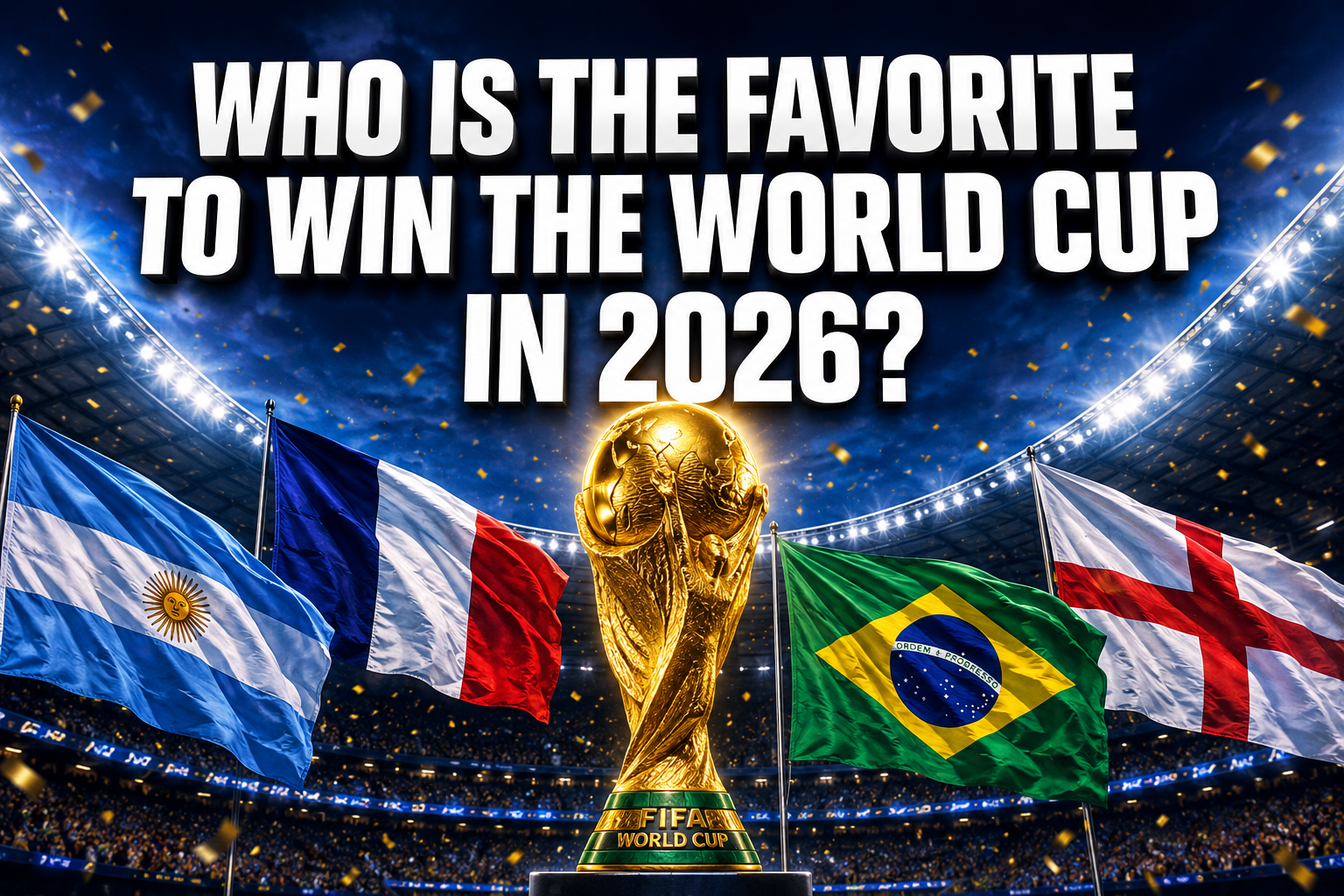
Argentina leads most sportsbooks as the favorite to win the 2026 World Cup, with odds typically ranging from +450 to +550, followed closely by France (+500 to +600) and Brazil (+600 to +700). England and Spain round out the top five favorites, while host nations USA, Canada, and Mexico are considered dark horses with significantly longer odds but potential home advantage benefits.
World Cup in 2026 Favorite Win
- Argentina remains the betting favorite despite being defending champions, a historically difficult position
- France and Brazil are considered co-favorites by many analysts due to their young talent and strong qualifying performances
- England’s “golden generation” makes them a consistent top-five pick across all major sportsbooks
- Host nation advantage could benefit USA, Canada, and Mexico, though none are considered top-tier favorites
- Spain’s recent success in international competitions has elevated their 2026 World Cup odds
- Portugal and Netherlands are popular dark horse selections with veteran leadership
- Betting odds fluctuate based on qualifying results, injuries, and team form leading up to the tournament
- The expanded 48-team format creates more opportunities for surprise results from lower-ranked nations
- Traditional powerhouses Germany and Italy face questions about their current form and squad depth
- Most experts agree the 2026 tournament will be the most competitive World Cup in history
Current Betting Favorites and Odds for the 2026 World Cup
Argentina sits atop most sportsbooks’ odds boards with prices typically between +450 and +550, making them slight favorites to repeat as world champions. This positioning reflects their recent World Cup victory, Copa America success, and the continued presence of Lionel Messi, even as he approaches his late thirties.
France follows as the second favorite at most books, with odds ranging from +500 to +600. Les Bleus benefit from an exceptionally deep squad featuring Kylian Mbappe in his prime, along with emerging talents like Eduardo Camavinga and Aurelien Tchouameni. Their runner-up finish in Qatar 2022 and strong Nations League performances have maintained their status as tournament favorites.
Brazil rounds out the top three at +600 to +700 odds. The Selecao’s young core, including Vinicius Junior, Rodrygo, and Endrick, represents a new generation ready to end Brazil’s World Cup drought that dates back to 2002. Their qualifying campaign performance will be crucial in determining their final pre-tournament odds.
Current Top 10 Favorites (Average Odds):
- Argentina: +500
- France: +550
- Brazil: +650
- England: +750
- Spain: +900
- Portugal: +1200
- Netherlands: +1400
- Germany: +1600
- Italy: +1800
- Belgium: +2000
How Are 2026 World Cup Favorites Determined?
Sportsbooks and analysts determine World Cup favorites through a combination of quantitative metrics and qualitative assessments. FIFA world rankings provide a baseline, but recent tournament performance, squad depth, and tactical evolution carry more weight in odds-setting.
Key factors include current player form, age profiles of key squad members, and managerial stability. Teams with players in their prime years (25-29) typically receive favorable odds, while squads dependent on aging stars or unproven youth face longer odds.
Qualifying campaign results significantly impact pre-tournament odds. Teams that struggle in qualification or rely heavily on playoff scenarios see their odds lengthen, while dominant qualifiers often see their prices shorten. The expanded 48-team format means more nations will qualify, but traditional powers still dominate the favorites list.
Primary Odds-Setting Factors:
- Recent major tournament results (last two World Cups and continental championships)
- Current FIFA ranking and coefficient performance
- Squad age profile and player development trajectory
- Qualifying campaign performance and margin of victory
- Managerial experience and tactical system stability
- Injury reports and player availability concerns
Argentina’s Chances to Repeat as 2026 World Cup Champions
Argentina faces the historical challenge of becoming the first nation since Brazil (1958, 1962) to win consecutive World Cups. The Albiceleste’s odds reflect both their recent success and the difficulty of repeating as champions in modern football.
Lionel Messi’s participation remains the biggest question mark. At 39 years old during the 2026 tournament, his role would likely shift from primary creator to veteran leader. Argentina’s success may depend on how well players like Julian Alvarez, Enzo Fernandez, and Alexis Mac Allister develop into starring roles.
The team’s core from their Qatar 2022 triumph will still be in their prime, with Emiliano Martinez, Cristian Romero, and Lautaro Martinez providing stability. However, the psychological pressure of defending champions and increased tactical preparation from opponents creates additional challenges.
Argentina’s path to repeating depends heavily on maintaining their defensive solidity while evolving their attack beyond Messi-dependence. Their Copa America performances in 2024 provided a blueprint for this transition, showcasing improved depth and tactical flexibility.
France as 2026 World Cup Favorites: Strengths and Concerns
France enters 2026 with arguably the most talented squad in world football, led by Kylian Mbappe at the peak of his powers. The 2018 champions and 2022 runners-up possess exceptional depth across all positions, making them many experts’ pick to win their third World Cup.
Their midfield combination of Aurelien Tchouameni, Eduardo Camavinga, and Youssouf Fofana represents one of the youngest and most dynamic cores in international football. Defensively, players like William Saliba and Dayot Upamecano provide pace and ball-playing ability that suits modern tactical demands.
However, France faces questions about their striker position beyond Mbappe and potential over-reliance on individual brilliance. Their recent Nations League performances have shown vulnerability against well-organized defensive teams, a concern for knockout tournament play.
The French Football Federation’s youth development system continues producing elite talent, giving France unmatched squad depth. This depth could prove crucial in a tournament featuring extreme travel distances across North America and potential fixture congestion.
Brazil’s 2026 World Cup Prediction and New Generation
Brazil enters the 2026 World Cup cycle with renewed optimism behind a generation of players who grew up watching their country’s World Cup drought. Stars like Vinicius Junior, Rodrygo, and promising young striker Endrick represent the most exciting Brazilian attacking talent in over a decade.
The Selecao’s tactical evolution under recent management has emphasized high pressing and quick transitions, moving away from the traditional jogo bonito style. This modern approach, combined with technical excellence, makes Brazil a formidable tournament threat.
Defensive improvements remain crucial for Brazil’s championship hopes. The emergence of players like Eder Militao and Gabriel Magalhaes provides hope, but consistency in defensive organization has plagued recent Brazilian teams in crucial matches.
Brazil’s qualifying campaign will be closely watched, as CONMEBOL’s competitive nature provides excellent preparation for World Cup intensity. Their ability to handle pressure situations and close out important matches will determine whether they can end their 24-year World Cup drought.
England’s World Cup 2026 Odds and Golden Generation Potential
England’s “golden generation” enters 2026 with their best chance to win a first World Cup since 1966. Players like Jude Bellingham, Phil Foden, and Bukayo Saka will be in their prime, while Harry Kane provides proven goal-scoring ability at the highest level.
The Three Lions’ tactical flexibility under Gareth Southgate’s successor will be crucial. England’s ability to adapt their system based on opponent strengths has improved significantly, moving beyond their traditional 4-4-2 limitations to embrace more fluid formations.
Depth across all positions gives England advantages in tournament scenarios. Their Premier League experience provides tactical familiarity and physical preparation for high-intensity matches, while their penalty shootout improvements address historical weaknesses.
England’s main challenge involves managing expectations and pressure. Their recent tournament near-misses (2018 World Cup semifinal, Euro 2020 final, Euro 2024 final) have created enormous public expectation for success in 2026.
Dark Horse Teams for the 2026 World Cup
Several nations outside the traditional favorites possess realistic chances of making deep tournament runs. Portugal, despite Cristiano Ronaldo’s likely absence, boasts exceptional young talent in Bruno Fernandez, Rafael Leao, and Joao Felix, making them dangerous knockout opponents.
The Netherlands continues producing tactically sophisticated teams capable of tournament success. Their total football philosophy, combined with players like Virgil van Dijk and Frenkie de Jong, creates a well-balanced squad that performs above individual talent levels.
Denmark’s Euro 2020 semifinal run demonstrated their tournament pedigree, while Croatia’s aging golden generation makes 2026 potentially their final opportunity for major tournament success. Both nations excel in tournament scenarios through tactical discipline and mental toughness.
Top Dark Horse Candidates:
- Portugal: Exceptional attacking talent, proven tournament experience
- Netherlands: Tactical sophistication, defensive stability
- Denmark: Tournament pedigree, team chemistry
- Croatia: Veteran leadership, technical excellence
- Uruguay: South American qualifying toughness, defensive organization
- Morocco: African champions with European-based talent
Host Countries’ Advantage: USA, Canada, and Mexico’s 2026 Chances
The United States enters 2026 with their strongest-ever World Cup squad, featuring Christian Pulisic, Weston McKennie, and Yunus Musah in their prime years. Home advantage, combined with improved player development through MLS and European experience, creates realistic hopes for a quarterfinal appearance.
Canada’s qualification for Qatar 2022 marked their return to World Cup football, and 2026 represents an opportunity to establish themselves as a consistent CONCACAF power. Players like Alphonso Davies and Jonathan David provide star quality, while home support could inspire overachievement.
Mexico faces a transitional period as their golden generation ages out, but home advantage historically benefits CONCACAF nations significantly. El Tri’s World Cup experience and passionate fan support make them dangerous opponents for any visiting team, particularly in group stage matches.
The expanded tournament format benefits all three host nations by providing additional qualification spots and favorable seeding scenarios. However, none are considered realistic title contenders by major sportsbooks, with odds typically ranging from +2500 to +5000.
What Happened to Past World Cup Favorites
Historical analysis reveals that pre-tournament favorites win the World Cup approximately 40% of the time, with the remaining 60% of tournaments producing surprise champions or dark horse winners. This pattern suggests 2026 could easily produce an unexpected result despite current odds.
Recent tournaments have seen favorites stumble due to various factors: Germany’s group stage exit in 2018, Brazil’s semifinal collapse in 2014, and Spain’s early elimination in 2022. These results demonstrate that tournament football’s knockout format creates vulnerability for even the strongest teams.
The expanded 48-team format introduces additional variables that could benefit underdogs. More group stage matches mean increased chances for upsets, while the new knockout structure provides additional opportunities for lower-ranked teams to gain momentum.
Successful World Cup winners typically combine individual talent with tactical flexibility, mental toughness, and favorable draws. Teams that adapt their playing style during tournaments often outperform those rigidly committed to single tactical approaches.
Updated Betting Market Trends and Expert Predictions
Current betting markets show remarkable stability in the top three favorites, with Argentina, France, and Brazil maintaining consistent odds across major sportsbooks. This stability reflects widespread consensus about these teams’ superior talent and recent performance levels.
England’s odds have shortened following their Euro 2024 final appearance, while Spain’s recent international success has elevated their position among second-tier favorites. Germany and Italy, traditional powers, face longer odds due to recent tournament disappointments and squad transition periods.
Expert predictions generally align with betting markets, though many analysts emphasize the tournament’s unpredictable nature. The consensus view suggests 2026 will feature the most competitive World Cup in history, with 8-10 teams possessing realistic championship chances.
Market Movement Factors to Watch:
- Qualifying campaign results and performances
- Major player injuries or transfers
- Managerial changes and tactical evolution
- Continental championship results in 2025
- Form of key players in domestic leagues
For comprehensive tournament information, including the World Cup 2026 bracket format and complete schedule details, fans can access detailed guides covering all aspects of the expanded tournament structure.
Frequently Asked Questions
Who is currently favored to win the 2026 World Cup?
Argentina leads most sportsbooks with odds around +500, followed by France (+550) and Brazil (+650). These three teams are considered co-favorites by most analysts.
Will Lionel Messi play in the 2026 World Cup?
Messi will be 39 years old during the tournament. While he hasn’t officially confirmed his participation, his recent statements suggest 2026 could be his final World Cup appearance.
How does the expanded 48-team format affect favorites?
The larger tournament creates more opportunities for upsets but doesn’t significantly change championship odds for top teams. Traditional powers still dominate betting markets despite increased competition.
Which host nation has the best chance of winning?
The United States has the strongest odds among host nations at approximately +2500, followed by Mexico (+3500) and Canada (+5000). None are considered realistic title contenders.
What makes France such a strong favorite?
France combines Kylian Mbappe in his prime with exceptional squad depth and recent tournament success (2018 champions, 2022 runners-up). Their young core provides long-term stability.
Are there any surprise teams to watch?
Portugal, Netherlands, and Denmark are popular dark horse selections. Morocco’s African Cup success and strong European-based player pool also makes them intriguing outsiders.
How accurate are pre-tournament World Cup odds?
Favorites win approximately 40% of World Cups, meaning upsets are common. The tournament’s knockout format creates vulnerability for even the strongest teams.
When will final odds be set for the 2026 World Cup?
Final odds typically emerge 2-3 months before the tournament begins, after all qualifying is complete and final squads are announced. Current odds will fluctuate significantly based on qualifying results.
Which traditional power faces the biggest questions?
Germany and Italy both face significant questions about squad quality and tactical direction. Both have struggled in recent major tournaments despite their historical success.
How important is the qualifying campaign for determining favorites?
Qualifying performance significantly impacts odds, especially for teams that struggle or dominate their regions. Strong qualifying campaigns often lead to shortened odds and increased confidence.
What role does managerial experience play in World Cup success?
Tournament-experienced managers provide significant advantages in knockout scenarios. Teams with proven tournament managers often outperform their talent levels in crucial matches.
Will the 2026 World Cup be the most competitive ever?
Most experts believe so, citing the expanded format, global talent distribution improvements, and the strength of 8-10 legitimate contenders for the first time in World Cup history.
Conclusion
The question of who is the favorite to win the World Cup in 2026 reveals a tournament landscape more competitive than ever before. Argentina’s position as betting favorite reflects their recent success, but France and Brazil possess equally compelling cases for championship contention. England’s golden generation and Spain’s tactical evolution round out a top tier of genuine contenders.
The expanded 48-team format introduces new variables while maintaining the tournament’s unpredictable nature. Historical patterns suggest that while favorites win 40% of World Cups, the remaining 60% produce surprise champions, making 2026 potentially the most open tournament in decades.
For fans looking to follow the tournament closely, understanding the complete schedule and opening ceremony details will enhance the viewing experience. The tournament’s North American setting promises unique challenges and opportunities for all participating nations.
As qualifying campaigns continue and squads evolve, odds will fluctuate significantly before final predictions emerge. The current favorites provide a solid foundation for understanding championship contenders, but football’s beautiful unpredictability ensures that 2026 will deliver surprises regardless of pre-tournament expectations.